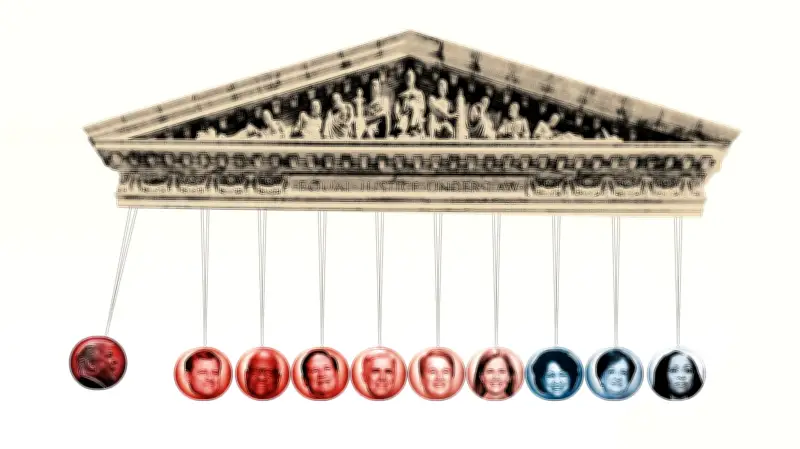
The Supreme Court on Monday issued two back-to-back blockbuster rulings on presidential power that appear contradictory on paper but, in reality, both serve President Donald Trump's priorities and the court's chief priority: protecting and expanding the power of corporations.
Trump v. Slaughter: Unfettered Presidential Removal Power
In Trump v. Slaughter, the court sided with Trump to overturn 90 years of precedent, ruling that presidents have unfettered power to fire agency officials for any reason, unrestricted by for-cause removal protections enacted by Congress. Chief Justice John Roberts wrote for the majority, stating, “We hold that such protection from removal is contrary to the separation of powers enshrined in the Constitution.”
Trump v. Cook: Federal Reserve Exemption
However, in Trump v. Cook, Roberts said this unquestionable executive power does not apply to the Federal Reserve. Trump had attempted to fire Federal Reserve Board Gov. Lisa Cook for cause over made-up claims of mortgage fraud. Roberts wrote, “The protection from removal enjoyed by Governors of the Federal Reserve is consistent with the Constitution.”

Roberts attempted to square the circle by stating in Slaughter that “our prior cases do not necessarily implicate the constitutionality of such arrangements,” and that the opinion “should not be read to do so either.”
Dubious Historical Distinction
The two decisions invent a distinction rooted in a highly dubious historical tradition of central bank independence. Roberts argued that the Federal Reserve is a successor to the First and Second Banks of the United States, even though those earlier iterations did not engage in monetary regulation nor were part of the executive branch. “What matters is that the Federal Reserve remains ‘consistent with the principles that underpin’ the First and Second Banks—namely, that monetary policy should not be subject to political interference,” Roberts wrote.
This analogy is questionable because the Federal Reserve, as the second independent executive branch regulatory agency created after the Interstate Commerce Commission, was created in much the same manner as any other executive branch agency. The Federal Trade Commission, whose protections were struck down in Slaughter, was created just one year after the Federal Reserve with the same for-cause removal protections.
Kavanaugh's Policy Rationale
In a concurrence in Cook, Justice Brett Kavanaugh, the only conservative to join Roberts in both majorities, provided a more material explanation. He argued that not protecting the Federal Reserve would “create significant uncertainty” and “expose the Federal Reserve to political influences and jeopardize the efficacy of U.S. monetary policy,” potentially leading to “turmoil in the U.S. and world economies.” He added, “I would not go down that road.”
Protecting Capital
Graham Steele, a former Treasury Department regulator under President Joe Biden, said, “The court’s position that the Federal Reserve is special and has special protections but other agencies like the Federal Trade Commission are subject to partisan whims of this president – when put together underscores that, for this court, capital has a special status.”
The decision protects banks, investors, corporations, and capital flows by safeguarding the Federal Reserve's independence, while leaving agencies like the FTC vulnerable. The FTC, as the chief antitrust and consumer protection regulator, can sue to break up monopolies, investigate large corporations, and enforce consumer protections—actions that capital does not favor.
Pay-to-Play Scandals
Trump has used his unitary control over such agencies to his benefit. Amazon contributed $1 million to his inauguration, paid $28 million to first lady Melania Trump to make a documentary, and contributed to Trump's White House ballroom construction project. The FTC subsequently settled an investigation into Amazon in a manner beneficial to the company. Alvaro Bedoya, a former FTC commissioner fired by Trump, said, “What this decision will do is let what has been a powerful corporate watchdog become a little lapdog for the president’s golfing buddies.”

Bedoya added, “Just how telling it is that this Supreme Court thinks that the bankers on Wall Street need their independent, above-the-fray regulator while the rest of us get stuck with the loyalists.”
Thus, the court's seeming contradiction is resolved: both rulings serve to protect corporate power, whether by insulating the Federal Reserve from political interference or by subjecting regulatory agencies to presidential control.