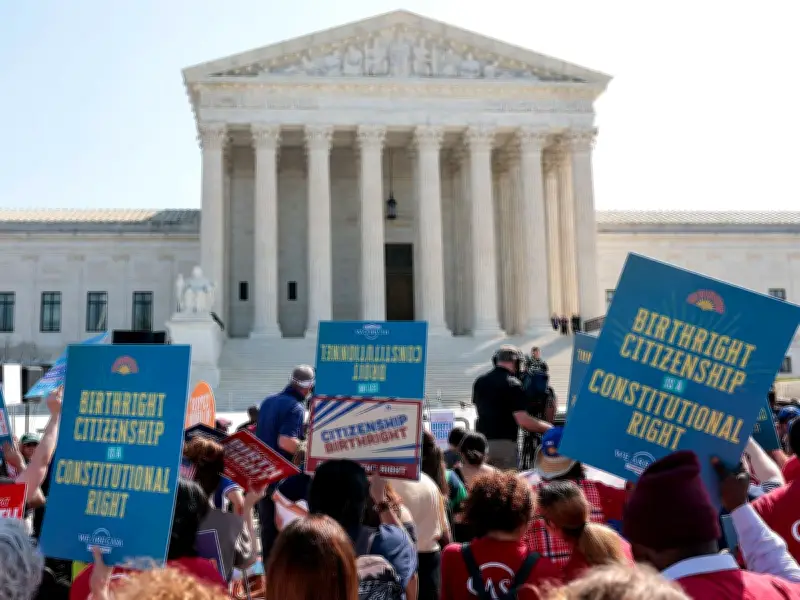
The U.S. Supreme Court on Tuesday struck down President Donald Trump's executive order restricting birthright citizenship, ruling that the measure conflicts with the Constitution's 14th Amendment. The 6-3 decision invalidates a central plank of Trump's immigration agenda, affecting an estimated 250,000 children born to undocumented immigrants and temporary visitors each year.
Court's Ruling and Reasoning
Chief Justice John Roberts, writing for the majority, emphasized the historical significance of birthright citizenship. 'Citizenship, then and now, was the right to have rights — to freely participate in our political community,' Roberts wrote. 'The framers of the Fourteenth Amendment extended that promise to every free-born person in this land. We keep that promise today.'
The court found that Trump's executive order, issued hours after his inauguration in 2025, could not be reconciled with the 14th Amendment, which has long been interpreted to grant citizenship to virtually anyone born on U.S. soil. The order sought to limit birthright citizenship to babies with at least one parent who is a U.S. citizen or lawful permanent resident.

Dissenting and Concurring Opinions
Justice Brett Kavanaugh, while joining the majority in invalidating the order, disagreed with the constitutional analysis. He argued the order should be struck down under a federal statute instead. The three conservative justices dissented, though their opinions were not immediately detailed.
Kavanaugh's concurrence suggested Congress could potentially amend immigration laws to restrict birthright citizenship, though it remains uncertain whether such legislation would withstand Supreme Court scrutiny.
Trump's Response and Legislative Reactions
President Trump downplayed the ruling, posting on social media that 'we could easily make it up in Congress through Legislation.' He urged Congress to 'start TODAY to work on ending expensive and unfair to our Country, Birthright Citizenship.'
The Justice Department announced it would 'prioritize the prosecutions of birth tourism schemes across the country,' including prosecuting individuals who lie on visa applications about their purpose of travel.
Hard-Line Conservative Pushback
Hard-line conservatives reacted swiftly. Representative Lauren Boebert of Colorado called on the State Department to stop approving visas for pregnant applicants. Representative Andy Ogles of Tennessee introduced legislation to ban pregnant foreigners from entering the U.S., though the bill has virtually no chance of passing the Senate, where it would need 60 votes.
Historical Context
The 14th Amendment, ratified in 1868 after the Civil War, guarantees citizenship to anyone born in the U.S. and 'subject to the jurisdiction thereof.' Critics of Trump's order argued he was attempting to rewrite this provision, which was designed to cover the children of freed slaves. Federal immigration statutes from 1940 and 1952 use identical language, reinforcing the longstanding interpretation.