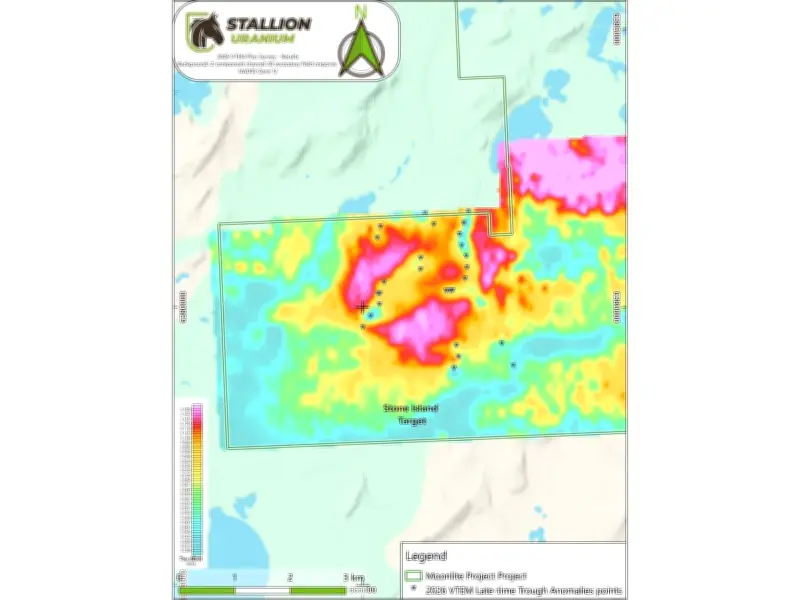
Stallion Uranium Corp. has completed its interpretation of a Versatile Time Domain Electromagnetic (VTEM) Plus airborne survey and magnetic data over the Stone Island Target on its Moonlite Project in the Southwestern Athabasca Basin, identifying multiple priority conductive trends and structurally controlled target areas for follow-up exploration.
Survey Details and Key Findings
The VTEM Plus survey, conducted by Geotech Ltd., comprised two grids south of the company's flagship Coyote Target. It was designed to refine conductive structural corridors and identify additional drill targets across the broader Moonlite property. Integration of VTEM data with magnetic tilt derivative data has defined four priority target areas, labeled A through D, at Stone Island.
Strong to moderate Tau responses delineate graphitic basement conductors, consistent with uranium-bearing systems in the Athabasca Basin. Multiple parallel to sub-parallel conductive trends outline a broad structural corridor. Magnetic tilt derivative highlights structural breaks, offsets, and cross-cutting lineaments, enhancing interpretation of fault-controlled architecture. Priority targets occur along conductor margins and zones of structural disruption, favourable for uranium mineralization.

Management Commentary
Matthew Schwab, CEO of Stallion, stated, “We are now clearly defining multiple priority target areas at the Stone Island Target through the integration of VTEM and magnetic data. The identification of several discrete targets significantly expands our exploration pipeline and reinforces the broader potential of the Moonlite Project within the Southwestern Athabasca Basin.”
Darren Slugoski, Vice President Exploration, added, “The VTEM Plus data has outlined a strong conductive corridor with multiple parallel trends, and magnetic tilt interpretation has highlighted the structural controls on these conductors. Importantly, our first completed drill hole at Coyote intersected graphitic faulting and significant alteration, providing strong validation of our geophysical targeting approach. We are now focused on refining these targets through modelling and advancing them toward systematic drill testing.”
Next Steps
Plate modelling and inversion are underway to refine conductor geometry, depth, and drill targeting. The company plans to advance these priority targets toward systematic drill testing, building on the successful validation from the Coyote drill hole.