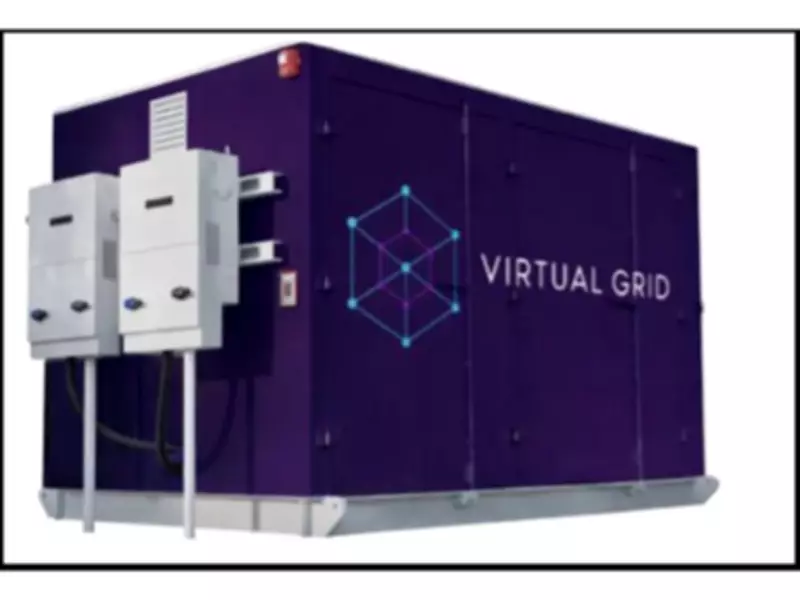
Virtual Grid Inc. has achieved a significant milestone with the deployment of its first prototype modular compute node, establishing the foundation for a distributed network of GPU-powered, battery-backed infrastructure across Western Canada. This move transitions the company from conceptual development to live AI infrastructure, with multiple customers already in the pipeline and immediate revenue anticipated from the initial deployment.
From Vision to Deployed Infrastructure
The prototype node represents the first operational version of Virtual Grid's innovative platform, designed to function as both a Virtual Data Center and a Virtual Power Plant. By integrating high-performance compute capabilities with on-site energy storage systems, Virtual Grid is pioneering a new model for AI infrastructure that promises faster deployment, enhanced resilience, and better alignment with power-constrained growth challenges.
Addressing Traditional Data Centre Limitations
Timothy Murphy, Chief Executive Officer of Virtual Grid, emphasized the importance of this deployment: "This marks the point at which Virtual Grid moves from vision to deployed infrastructure. We have now deployed the first prototype node of a platform that we believe is built for the direction of the AI market. Demand for compute continues to accelerate, while traditional data centre models are increasingly slow to deploy, capital-intensive, and constrained by power availability. Virtual Grid is designed to address those challenges."

John Hawes, Chief Operating Officer, added: "Traditional data centres were built for a different era. Virtual Grid is taking a modular, distributed approach that is designed to support faster rollout, built-in redundancy, and more flexible scaling. This first prototype is an important step toward that broader network."
Architecture Designed for High-Performance Workloads
Virtual Grid's architecture is specifically engineered to handle GPU-intensive workloads, including:
- AI inference and fine-tuning
- Machine learning applications
- Advanced analytics processing
- Rendering and simulation tasks
Over time, the company expects its battery-backed nodes to serve not only as distributed compute assets but also as coordinated energy assets across the network, creating a dual-function infrastructure system.
Validation and Future Expansion
Chris Zinger, Chief Technology Officer, noted: "This first prototype validates the architecture, the deployment model, and the commercial thesis. The focus now is on refinement, execution, and scale."
The company has previously disclosed that it has 75 locations under development through memoranda of understanding across Western Canada and is pursuing phased activation as it expands its operational footprint. This strategic approach allows for gradual scaling while maintaining quality control and operational efficiency.
The deployment in Edmonton, Alberta, represents a critical step in Virtual Grid's mission to create a decentralized, scalable, and energy-aware architecture that can support the growing demands of AI and high-performance computing applications in the region.