Jennifer Sontag thought she had packed appropriately for a Spanish beach. As an American, she wore a conservative one-piece swimsuit with a T-shirt cover-up. Her octogenarian Spanish mother-in-law took one look at her, then at the rest of the beach—where women ranging from topless toddlers to 80-year-olds in bikinis were enjoying themselves without any fuss—and delivered the verdict: “Everybody has a beach body.”
Sontag had not packed wrong by American standards. The problem is that American standards do not travel. On a Spanish beach, a T-shirt cover-up and a modest one-piece make you the odd one out. What she encountered is the first rule of international beaches: swimwear is a passport, and everyone on the beach can see which country you come from.
Swimwear as a Cultural Passport
David Ratmoko has spent 15 years casting models for swimwear campaigns across Europe, the Middle East, Asia, and the Americas. He sees the same thing in every casting room. “The most culturally honest piece of clothing is swimwear,” he said. A French Riviera client once requested models with “minimal tan line potential,” a casting note that would never come from an American or Asian client. He has also watched male models get redirected on set because their swimwear was too European for an American campaign. “No one writes that note to women, but the restriction on men is just as real.”

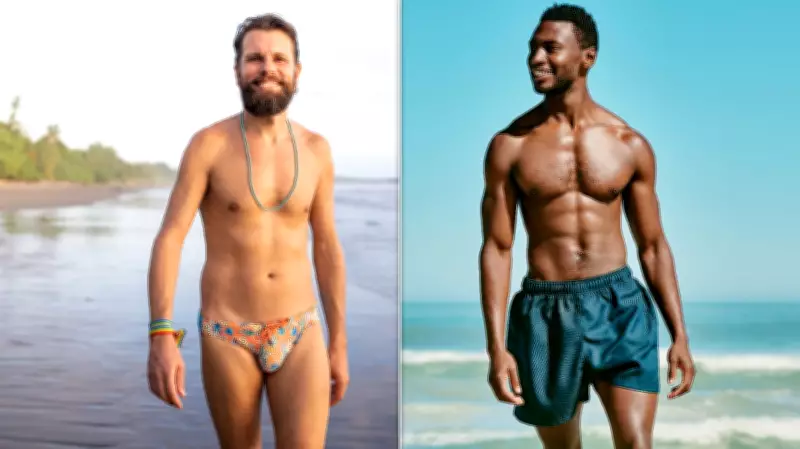
The restriction on men is where the cultural coding shows up most visibly, because it is where the gap between nations is widest. Sue McGarvie, a clinical sex counselor who has spent 40 years on clothing-optional beaches from Cap d’Agde to the Caribbean, has a working theory about this. “In France, tiny Speedos are masculine confidence. In Australia, budgie smugglers are national pride. In North America, board shorts are security blankets.”
Australian Budgie Smugglers and Italian Speedos
As an Aussie, I should explain the term budgie smuggler. The name comes from the outline left by a small, brightly colored bird stuffed into something too small for it. I will leave the rest to your imagination, but three categories of Australian men wear it: surf lifeguards, who have a job to do; influencers, who have an algorithm to please; and men over 60, who have simply stopped caring what others think.
Italian men have their own version of the same confidence. American traveler Maddison Ryan noticed on a trip to Italy that men of every age wore Speedos, and that there was a practical case behind the tradition. “Easier for tanning, dries faster, and they claim to be comfortable. Young men to old are all wearing them, and they all look very happy.”
Why Americans Cover Up
So why do not Americans dress like that? “In the U.S., so much attention is placed on the size and shape of our bodies, often with an unspoken belief that smaller is better,” said body image psychotherapist Francesca Emma. “Without fitting a certain ideal, there can be a quiet sense of modesty, self-consciousness, or even shame.” On Mediterranean beaches, she said, the contrast is immediate. “You can often spot an American within seconds — not by appearance, but by the way they relate to their body.”
Europeans who have lived in more relaxed places see the same thing. Amanda Molenaar, a former Dutch diplomat, lived in Brazil for three years and walked onto Copacabana Beach in a standard European bikini, only to feel conspicuous within minutes. “Coming from Western Europe, where bigger bikini bottoms are the norm, I stood out. But I love the Brazilian body confidence. All shapes, sizes and colors, and everyone comfortable in their skin.” By the time she moved back to the Netherlands, she had absorbed enough of it that she found herself baffled by her own country. “I just thought, why are you hiding your beautiful body?”

From Spain to Santa Monica
Tiana Pongs moved from Spain to America and saw the contrast firsthand. A German consultant who has lived in both Mallorca and Los Angeles, she used to watch Spanish office workers strip naked for a lunchtime swim and head back to work. “From teenagers to grandparents, it is simply normal there. A body is just a body. It is not a sexual statement.” Then she moved to Santa Monica, and despite it being the same ocean, the beachgoers dressed differently. “People are covered, perfectly styled, and everything feels performative.”
Modesty in the Middle East and South Korea
The rules change completely in the Middle East. Dawn Younts, an American living in Egypt, recalls one afternoon on the Red Sea. “On the same beach, I saw a European woman sunbathing topless who was later politely asked to cover up, and nearby, Egyptian women swimming in full-coverage swimwear, including long-sleeve suits and head coverings. Everything existed in between those two extremes, all in the same space.” Women dressed for entirely different centuries, sharing the same water.
But modesty on a beach is not always about religion. In South Korea, beachgoers cover up for reasons that have nothing to do with faith. British expat Michelle O’Donnell turned up to a Korean beach expecting locals in swimwear and found them in long sleeves and full leg coverage. “Korea still follows old traditions dating back to royal and affluent people of trying to avoid the sun and tanning. The darker your skin, the lower-class you likely are, whereas the lighter your skin, the higher-class you must be.” On that beach, a tan told people where you worked.
The Man Who Defied All Codes
Every nationality so far has a code. Who covers, who does not, who gets judged for which. This is why McGarvie’s favorite story is about a man who ignored all of them. “Last week at Hidden Beach, Mexico, a gentleman strutted past our group wearing a neon-green Borat-style mankini that defied both gravity and good sense,” she said. “This was a magnificently large man who had clearly never met a confidence issue he could not conquer.” Her traveling companions burst into laughter. After forty years of clothing-optional beaches, McGarvie has one conclusion. “The truly confident ones are not always naked.”
Which, in its own way, is what Jennifer Sontag’s mother-in-law had been trying to tell her on that Spanish beach. Sontag eventually took the advice. She ditched the one-piece, bought a colorful bikini, and wore it. She has not gone back.