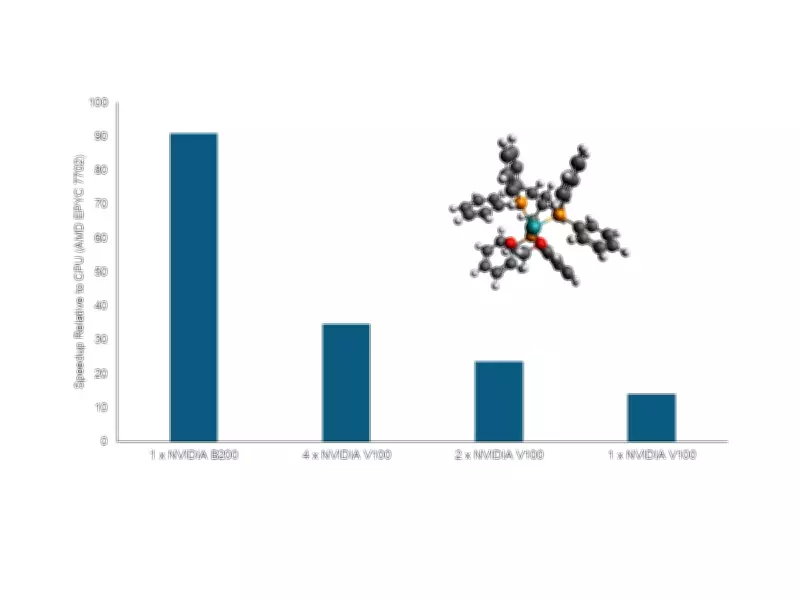
OTI Lumionics, a leader in advanced quantum simulations for next-generation materials discovery, has announced a significant breakthrough in computational chemistry. The company has successfully implemented its Iterative Qubit Coupled Cluster (iQCC) algorithm using NVIDIA accelerated computing, establishing a new benchmark for high-precision industrial material design simulations.
Revolutionizing Material Discovery with Quantum-Inspired Algorithms
This innovation allows for the simulation of complex molecular systems with unprecedented efficiency, speed, and accuracy. Traditionally, high-precision simulations of such systems have required extensive supercomputing clusters to achieve desired results, often taking days or even weeks to complete.
Breakthrough Performance on a Single GPU
By migrating workloads from traditional CPU-intensive environments to a single NVIDIA Blackwell GPU, OTI Lumionics achieved a remarkable 90x performance increase. This reduced individual calculation steps from several days to just about one hour, dramatically expanding the practical application of the iQCC algorithm.

Mehdi Jenab, Senior Research Scientist at OTI Lumionics, explained the significance: "We computed a single ground state energy variationally of a greenhouse gas emission capturing catalyst that needs 112 qubits, surpassing DMRG in just over an hour on a single NVIDIA Blackwell GPU. This result proves our quantum-inspired approach is the most viable path for complex chemistry, making geometry optimization feasible."
Setting a New Standard for Quantum Computing
Scott Genin, VP of Materials Discovery at OTI Lumionics, highlighted the broader implications: "This work sets a defined benchmark for what a quantum computer at the 100 to 120-qubit scale must achieve to outperform a quantum-inspired algorithm. Achieving low computational times on Blackwell GPUs means we are making accurate material structure simulation a practical reality today."
This advancement opens up multiple opportunities, including accurate structure determination of complex catalysts and generating high-accuracy data sets for AI in materials discovery.
Impact on Industries and Future Applications
With these advances, industries reliant on materials discovery, such as consumer electronics, automotive, and next-generation OLED display manufacturers, can accelerate their processes while eliminating the bottlenecks of traditional supercomputing. By demonstrating that quantum-inspired approaches deliver exceptional performance, OTI Lumionics is enabling faster, more accurate material design through algorithmic efficiency.
The successful implementation of the iQCC algorithm not only outperforms traditional quantum models but also paves the way for more accessible and cost-effective solutions in computational chemistry. This breakthrough is expected to drive innovation across various sectors, reducing time-to-market for new materials and enhancing sustainability efforts through improved catalyst design for environmental applications.