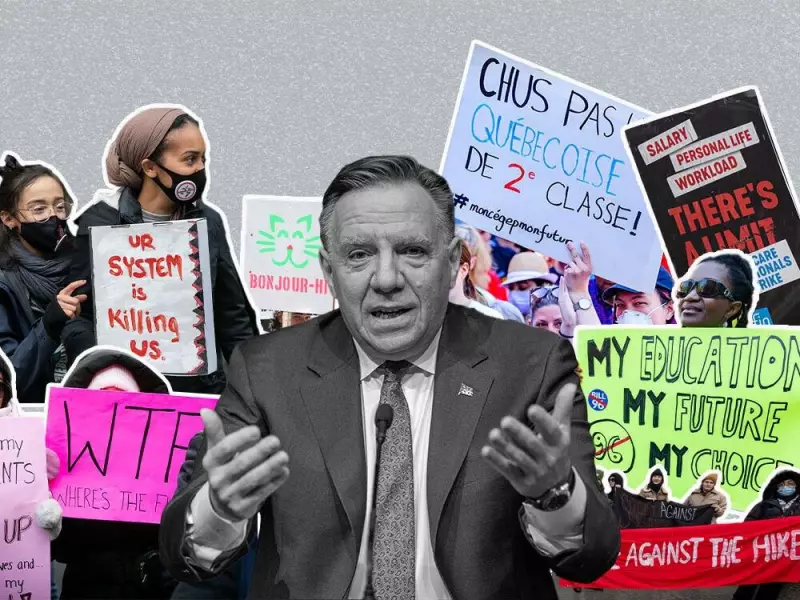
The political landscape in Quebec was reshaped this week with the resignation of Premier François Legault, a move that was widely anticipated given his party's precipitous decline in public opinion polls. The leader of the Coalition Avenir Québec (CAQ) announced his decision to step aside, a development that has elicited more relief than regret from many Quebecers who felt their rights were undermined during his time in office.
The Inevitable Exit After Polling Collapse
The resignation, delivered on Wednesday, January 17, 2026, followed a series of dismal polls for the CAQ. Most recently, a Pallas survey showed the party tied for last place, seemingly the final catalyst for Legault's departure. Political observers had long considered his exit inevitable, as projections suggested the CAQ faced potential electoral obliteration if he led the party into the anticipated fall election.
Legault, a former minister in the Parti Québécois government, founded the CAQ in 2011 with a vision of a "third way." His platform aimed to unite federalists and sovereignists under a single banner, focusing on Quebec's economic autonomy and cultural nationalism within Canada. This strategy propelled the party to strong majority victories in 2018 and 2022.

A Legacy of Promise and Polarization
Despite a formidable resume as an accountant, Air Transat founder, and former minister of education and health, Legault's tenure is widely viewed as a story of unfulfilled potential. He initially promised to move Quebec beyond the constitutional battles of the past and championed an ambitious vision of a high-tech "Silicon Valley" along the St. Lawrence River.
However, his government's record is checkered. Beyond its management of the COVID-19 pandemic, significant accomplishments are scarce. The province is grappling with its largest historical deficit, while the health care, education, and physical infrastructure systems are perceived to be in worse condition than before he took office. Major projects like Northvolt and the SAAQclic IT system were marred by costly blunders and insufficient oversight.
In his resignation address, Legault pointed to two signature pieces of legislation as achievements: Bill 21 on state secularism and Bill 96 strengthening the French language charter. While politically popular in certain quarters, critics argue these laws are largely symbolic. Bill 21 is seen as disproportionately affecting visible minorities in public sector jobs, and Bill 96's approach to protecting French is criticized for coercively restraining other languages and alienating minority communities.
Not a Premier for All Quebecers
His final speech underscored a consistent theme of his leadership. Legault again warned of immigration's impact on the "Quebec nation," a stance that solidified his reputation as a leader who did not represent all Quebecers, despite his 2018 proclamation to the contrary. For many who felt their rights were trampled, his departure prompts little sorrow.
As columnist Robert Libman noted, it is difficult to offer the customary homage upon a leader's resignation. While acknowledging the personal difficulty of Legault's decision, the legacy for many is one of division.
What Comes Next for the CAQ and Quebec
Attention now shifts to the race for Legault's successor and the potential reshaping of Quebec's political deck. The CAQ, a coalition held together largely by Legault's personal appeal, risks fracturing depending on the chosen leader.
Several cabinet ministers are considered likely contenders. Municipal Affairs Minister Geneviève Guilbault is reportedly organizing a team, while Environment Minister Bernard Drainville and Economy Minister Christine Frechette may also run. A leading candidate is Simon Jolin-Barrette, the minister who piloted Bills 21 and 96. Popular among nationalists and in his late 30s, his selection would set up a dynamic campaign against Liberal leader Charles Milliard and PQ leader Paul St-Pierre Plamondon, representing a new generational debate.
The leadership choice will have significant ripple effects. A staunch nationalist leader could push moderate CAQ members toward the Quebec Liberal Party and split the francophone nationalist vote with the PQ in key regions, indirectly aiding the Liberals.

This late-game change upends all previous assumptions about the upcoming election. Whoever becomes the next premier will inherit a Quebec that, in the view of many analysts, is a lesser place than it was before François Legault took power in 2018.