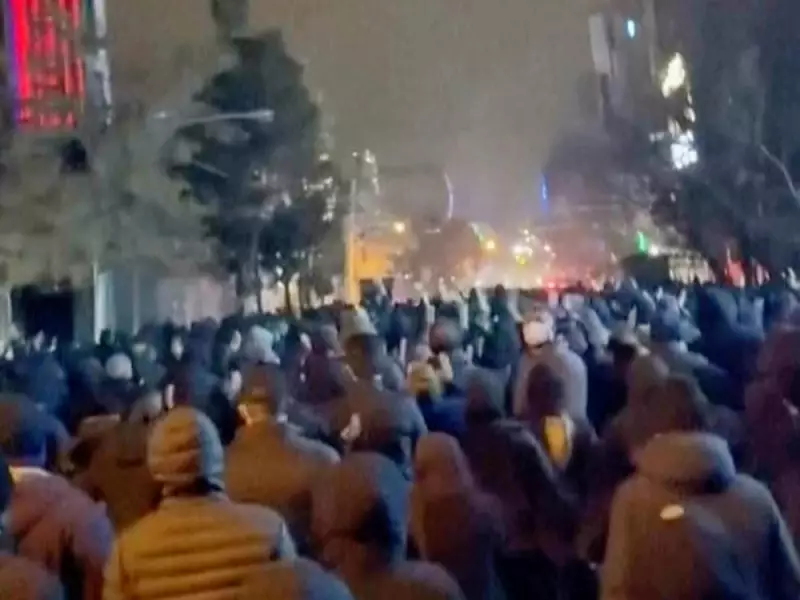
For twenty days, Iran has been engulfed in a wave of deadly and violent unrest, presenting a stark challenge to the authoritarian regime in Tehran. Observers report a brutal crackdown where security forces have used live ammunition against peaceful demonstrators, imposed widespread internet blackouts, and thrown thousands into prisons.
A Deadly Toll and Economic Despair
According to the Oslo-based monitoring group Iran Human Rights, the civilian death toll has reached at least 3,428, with thousands more injured. Analysts caution the actual number could be significantly higher. The protests ignited in Tehran's main bazaar, the nation's financial heart, as shopkeepers reacted to a collapsing currency and skyrocketing prices.
The demonstrations rapidly spread across major urban centers, and their focus broadened from economic grievances to a direct demand for an end to nearly five decades of theocratic rule. This shift marks a critical evolution in the public's demands.

Hussain Ehsani, a research fellow at the Washington, D.C.-based Turan Research Center, explains a key dynamic in Iranian political change. "In Iran’s political psychology, two factors are traditionally essential for a fundamental transformation," he said. "First, the bazaar must enter into sustained strikes and protests; second, the army must side with the people. Currently, the first condition has partially materialized."
The Radicalization of a Movement
The economic backdrop is dire. Over the past three years, Iran's currency has lost two-thirds of its value, while the cost of basic food items has surged by 72 per cent since last year. Compounding this crisis are severe shortages of water and energy in major cities, further stoking public fury.
While the Islamic Republic has weathered major protest cycles before—from the Green Movement in 2009 to the "Woman, Life, Freedom" uprising after Mahsa Amini's death in 2022—analysts see a crucial difference in the current moment.
"In 2009, it was still based on a disputed election. People were asking, ‘Where is my vote?’" said Kaveh Shahrooz, a senior fellow at Ottawa's Macdonald-Laurier Institute. "The message has really radicalized since then. The closest comparison is the 2022 movement. In both cases, the demand is for the regime to be overthrown."
International Pressure and an Uncertain Future
The external environment has also shifted. U.S. President Donald Trump has taken the protest crackdown to the United Nations Security Council and imposed sanctions on Iranian officials, including National Security Council secretary Ali Larijani. Trump has publicly urged protesters to "take over your institutions" and promised that "help is on its way," though the nature of that assistance remains ambiguous.
Despite reports of the protests calming somewhat by the end of the week, the underlying conditions remain volatile. The convergence of a radicalized populace, catastrophic economic failure, and heightened international scrutiny presents the Tehran regime with one of its most complex and sustained challenges to date. While analysts agree that street protests alone are unlikely to topple the government, the cumulative pressures suggest Iran is navigating uncharted and perilous territory.