Five years of national angst and anger over the 'discovery' of 'graves' at the former Kamloops Indian Residential School were driven by an archeological report by self-proclaimed activist archeologist and critical theory advocate Sarah Beaulieu. Her PhD thesis, completed in 2019, glorified her social warrior and critical theory credentials.
In her thesis, 'Archaeology of Internment at the Morrissey WWI Camp,' insight into Beaulieu's philosophy is revealed in chapter two under the headings 'Critical Theory' and 'Applications of Critical Theory within Modern Conflict Archaeology.'
Critical Theory and Emancipatory Archaeology
Critical theory, she explained, has a dual purpose: exposing ideologies that justify oppression and forcing a commitment from the practitioner to act against oppression once exposed. 'Through the application of critical theory, researchers gain an understanding of how certain groups have become exploited. This understanding allows the researcher to use this knowledge and critique gained through research to strive to end such oppressive forces,' wrote Beaulieu, a professor at Fraser Valley University.

'Critical archaeologists thus take part in an emancipatory archaeology to serve marginalized societal groups and challenge the dominant class,' she added. Emancipatory archaeology and activism are one and the same thing, according to Beaulieu. She isn't just an archeologist doing her job; she is the force through which change is made.
'Emancipatory (activist) archaeology aims, through its conceptual frameworks and public outreach initiatives, to foster critical thought about the determinants of contemporary lived experience in hopes of impelling positive social change,' she wrote in her thesis, two years before the 2021 Kamloops 'findings.'
Neutrality Rejected
Beaulieu makes no bones about taking sides. 'Neutrality is a luxury that archaeologists are not afforded and they cannot be apolitical in the face of politics,' she wrote. She added, 'Creating an ethically engaged archaeology' places 'the needs of the victims, local and descendant communities first.'
For Beaulieu, a public accounting was also very much needed. 'Archaeologists share a responsibility not only to uncover the criminal acts of the perpetrators and bring justice to the victims but also to call to public attention such atrocities,' she wrote.
At one point, Beaulieu talked about how victims of war often have their stories re-written by different governments and of the need to challenge that oppression. 'Intrinsic to war are the transgressors and victims whose historical narrative is often re-written through the lens of shifting political regimes. Hence, the need to speak out against such injustices becomes the onus of society, and the field of archaeology can thus greatly contribute to social justice. It is this knowledge that will enlighten society so that it may rise up against historical, ongoing and future injustices.'
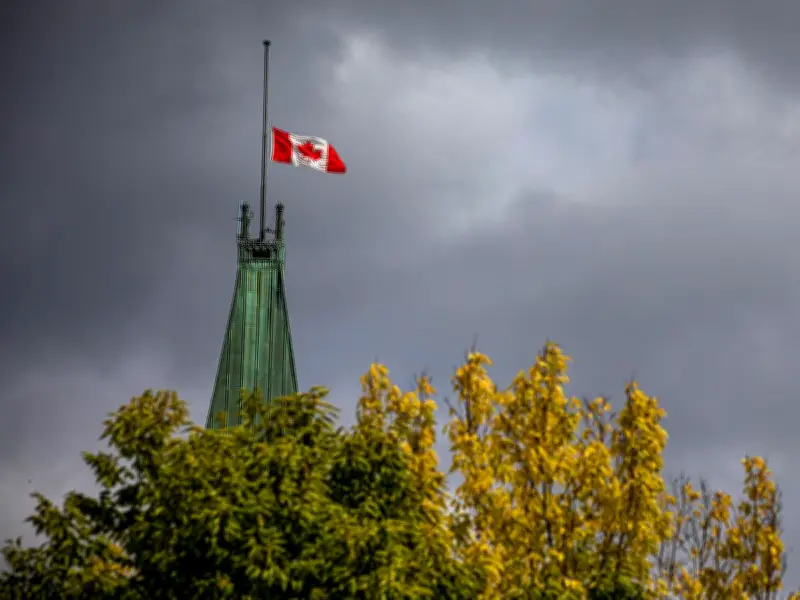
The Canadian flag at the Peace Tower on Parliament Hill and all other federal buildings were lowered for more than five months after the announcement that unmarked 'graves' were found outside the former Kamloops Indian Residential School. This event sparked a national conversation about the role of activism in archaeology and the interpretation of historical evidence.