

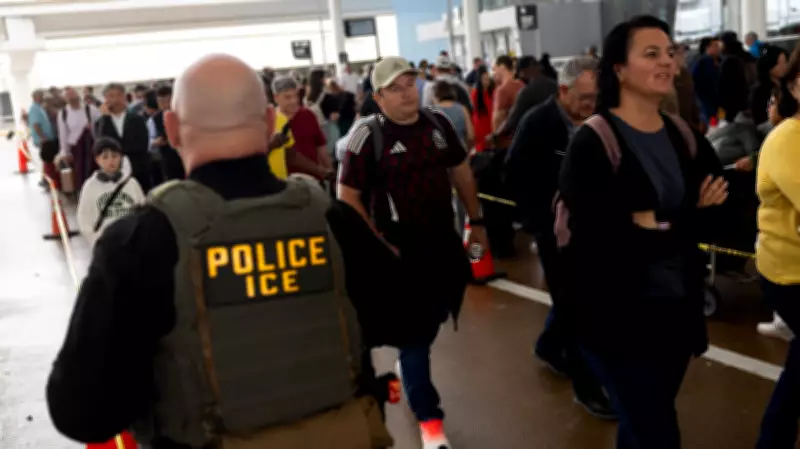
ICE Agents Deployed to U.S. Airports Amid Government Shutdown
Airport travelers across the United States are navigating chaotic crowds and extended security lines, while now also confronting the presence of armed Immigration and Customs Enforcement officers during their journeys. This week, under President Donald Trump's directives, ICE agents have been stationed at multiple U.S. airports, a move intended to pressure Democrats to resolve the ongoing government shutdown and address critical shortages of Transportation Security Administration personnel.
Staffing Crisis and Enforcement Presence
TSA officers have been working without pay for over a month, leading to unprecedented numbers of call-outs and resignations. Lauren Bis, a spokeswoman for the Department of Homeland Security, stated in an official communication that ICE's deployment "will help bolster TSA efforts to keep our skies safe and minimize air travel disruptions." However, she declined to specify the exact duties ICE will perform at airports or confirm the precise locations of officers.
Multiple media outlets have reported ICE presence in at least fourteen different airports, including John F. Kennedy International and La Guardia Airports in New York, Chicago-O'Hare International Airport, Luis Muñoz Marín International Airport in Puerto Rico, Louis Armstrong New Orleans International Airport, and Philadelphia International Airport. Border czar Tom Homan indicated on Monday that this number could expand, with ICE potentially appearing in "more" airports nationwide.

Rights and Risks for Travelers
While no airport arrests have been directly linked to this specific ICE deployment, President Trump has publicly expressed his desire for ICE's airport duties to include "the immediate arrest of all illegal immigrants." This declaration has prompted immigration advocates to urge travelers, both domestic and international, to be fully aware of their rights when encountering ICE at U.S. airports.
"The Trump administration is doing this to scare people," asserted Heidi Altman, vice president of policy at the National Immigration Law Center. She emphasized that non-citizens should conduct "an individual risk assessment" before heading to airports and prepare for worst-case scenarios.
Naureen Shah, director of policy and government affairs for immigration at the ACLU, advised that individuals who are undocumented or not U.S. citizens should "be ready and anticipate that you may be subject to extra screenings or questions from any of these officers." She recommended carrying proper documentation, including green cards and proof of pending immigration applications, and sharing copies with trusted family members.
Heightened Enforcement and Historical Context
Altman noted that even prior to these new orders, the administration has targeted individuals within the immigration court system who hold temporary status. In December, documents revealed collaboration between ICE and TSA, sharing names and birth dates of travelers with deportation orders, which led to the arrest and subsequent deportation of a college student at Boston Logan Airport.
With ICE's increased presence, Altman warned that arrest risks are "heightened" for those with deportation orders, even outdated ones, or temporary statuses like Deferred Action for Childhood Arrivals recipients. For high-risk individuals, she suggested considering alternatives to air travel or preparing arrest scenarios with loved ones, particularly for caregivers.
Constitutional Protections and Recording Rights
Travelers retain the right to record ICE activities at airports, a protected First Amendment activity in public locations, according to Saira Hussain, a senior staff attorney at the Electronic Frontier Foundation. While ICE may instruct bystanders to maintain distance, they cannot legally prevent recording or confiscate devices to suppress this right.
Hussain clarified that the "border search exception," which allows inspection of electronic devices at U.S. borders, does not apply merely for being in an airport. "When you're traveling domestically, you're not at the border," she explained, noting that attempted device searches by ICE in domestic airports could violate constitutional protections.

Political Stalemate and Ongoing Impact
ICE's airport presence may persist as the government shutdown continues without resolution. Democrats are demanding ICE reforms, including restrictions on agents wearing masks and stronger use-of-force standards, as conditions for funding the Department of Homeland Security. Meanwhile, President Trump has rejected compromises, introducing new demands related to election procedures.
Despite the tense environment, Shah affirmed that "the airport is not a Constitution-free zone," emphasizing that racial profiling or targeting based on religion or national origin remains illegal. All travelers, including U.S. citizens, should know their rights, such as the right to remain silent regarding citizenship status and the right to legal counsel if arrested.
"Be calm and have the phone number of a lawyer, and avoid sudden movements," Shah advised, summarizing guidance for these challenging circumstances. As airport environments grow more complex, awareness and preparation become essential for all travelers navigating this unprecedented enforcement landscape.





