Can suicide be murder? With Kenneth Law set to plead guilty to a lesser charge, the legal question may remain unanswered. The current leading precedent holds that an alleged murderer must overcome the victim's free will. Otherwise, voluntarily taking poison is said to break the chain of legal causation.
The Sting Operation
The British journalist's sting that brought Kenneth Law to the attention of Canadian police three years ago played out with high cinematic tension. Chasing reports of do-it-yourself poison kits marketed through an online suicide instructional chatroom and sold via a thinly disguised culinary supply website, Times of London reporter James Beal tracked what he believed to be Law's business to a post office box in a Mississauga, Ontario pharmacy.
Beal had spoken on the phone to a man he believed to be Law, posing as a customer. This man told him many of his customers had died from his product, so Beal and a photographer staked out the drug store from the parking lot on a cold winter day, hoping for a lucky break.

The Confrontation
A man arrived in a Lincoln Town Car carrying a bunch of packages. Law was startled to be approached, but he was initially willing to talk and invited the journalist to sit in his car. They spoke for six minutes. Law grew increasingly agitated and reportedly told Beal: "People do this but it's not my business. It's their life. They are killing themselves. I'm not doing anything. I'm just selling a product."
Beal escalated the interview, confronting Law with the allegation that he had effectively murdered a young British man whose father had helped Beal track Law's alleged online business. "If they have their intentions, I cannot stop them," Law said, according to The Times. "Perhaps you want to stop people from buying knives?" Law then ordered him out of the car.
The Arrest and Charges
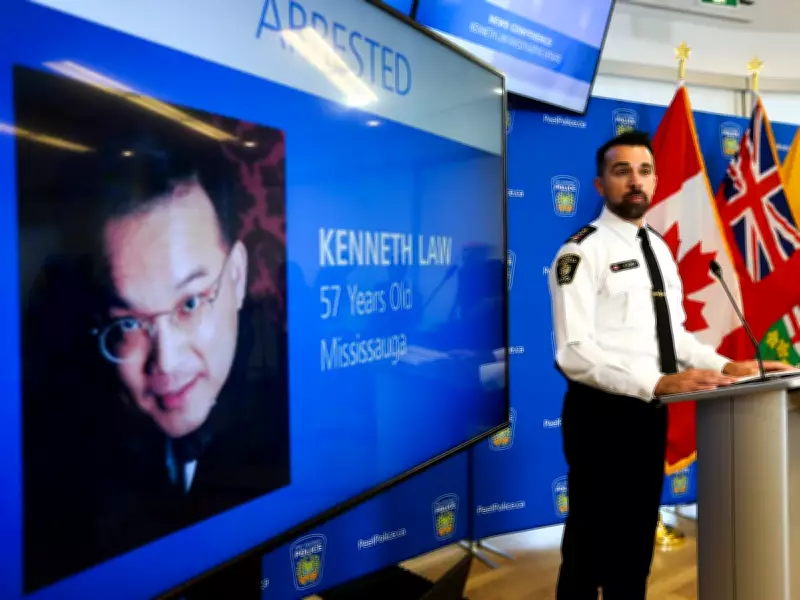
It was the beginning of the end for the alleged poison seller, whose business was allegedly global and has resulted in well over 100 deaths. A few weeks later, in May 2023, a week after The Times report was published, Peel Regional Police arrested Law, kicking off the most shocking Canadian prosecution in recent memory. They warned the public to be vigilant about online transactions and mailed packages, and listed several websites by name, allegedly connected to Law.
Law was originally charged with aiding suicide, first two counts and then 12 more, but after a few months his charges were upgraded to second-degree murder, and then to first-degree murder — planned and deliberate killing. This suggested both escalating seriousness of the evidence, but also perhaps an uncertainty about what specific crimes had actually been committed.
The Plea Deal
But the case will not go to trial. On Friday in a Newmarket, Ontario courtroom, Law, 60, intends to plead guilty to 14 charges of aiding suicide, according to his lawyer Matthew Gourlay. In exchange, the Crown is expected to abandon its charges of murder. The victims include adults and children, with ages spanning 16 to 36. All are understood to have purchased poison allegedly from Law through an online store.
Law is expected to make his plea in front of a senior judge of the Ontario Superior Court, Michelle Fuerst, who until a few weeks ago was set to hear his trial before a jury on the far more serious charges of first-degree murder. Conviction would have made Law one of Canada's most prolific murderers, with more victims than child killer Clifford Olson, Toronto van attacker Alek Minassian, or Elizabeth Wettlaufer, a nurse who poisoned patients.
Legal Implications
The plea deal leaves unresolved the fundamental legal question: can suicide be murder? Under Canadian law, for a murder conviction, the prosecution must prove that the accused caused the death and had the requisite intent. However, when a victim voluntarily takes a lethal substance, their own free will may break the chain of causation, making it aiding suicide rather than murder. This case highlights the tension between criminal liability and personal autonomy in assisted suicide cases.