

Taiwan's Opposition Leader Holds High-Stakes Meeting with Chinese President Xi Jinping
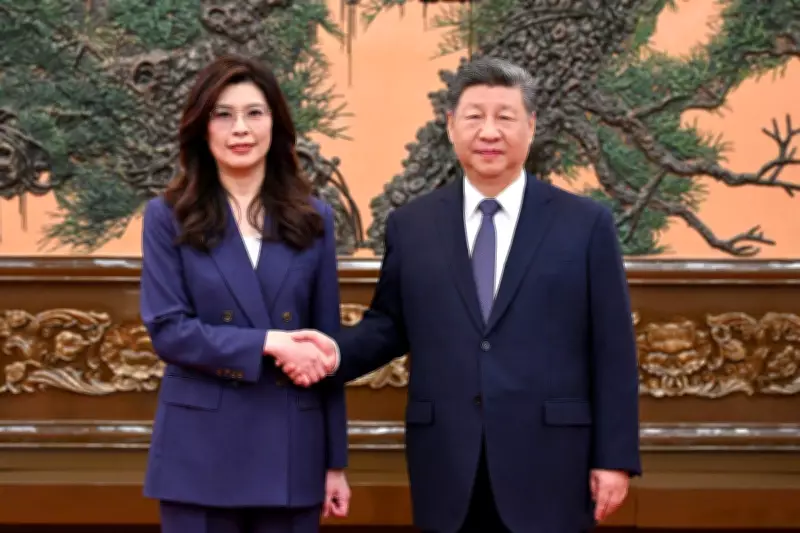
In a pivotal diplomatic encounter, the leader of Taiwan's primary opposition party, the Kuomintang (KMT), Cheng Li-wun, met with Chinese President Xi Jinping in Beijing on Friday, April 10, 2026. The meeting, which was documented by state media, underscored a mutual call for peace and stability in the Taiwan Strait, a region long fraught with geopolitical tensions.
A Symbolic Handshake Amidst Ongoing Strains
The encounter, captured in photographs released by Xinhua News Agency, featured President Xi Jinping and Cheng Li-wun engaging in a formal handshake. This gesture, while routine in diplomatic circles, carries profound significance given the complex and often contentious relationship between mainland China and Taiwan. Beijing views Taiwan as an inseparable part of its territory, a stance vehemently rejected by Taipei's current ruling Democratic Progressive Party (DPP), which advocates for Taiwan's sovereignty.
The Kuomintang, historically favoring closer ties with China, has positioned itself as a bridge for dialogue. Cheng Li-wun's visit represents a continuation of this role, aiming to foster communication channels that have been strained under the DPP's administration. Both leaders utilized the meeting to emphasize the importance of peaceful coexistence and the avoidance of conflict, though specific policy agreements or joint statements were not immediately disclosed.

Context of Cross-Strait Relations
This meeting occurs against a backdrop of heightened military activities and political rhetoric. China has consistently increased military drills near Taiwan, which it describes as necessary measures to deter separatist movements. Concurrently, Taiwan has bolstered its defenses and sought international support to maintain its de facto independence.
The Kuomintang's engagement with Beijing is often viewed as a counterbalance to the more confrontational approach of the DPP. By advocating for peace, Cheng Li-wun's dialogue with Xi Jinping may aim to reduce immediate tensions and explore avenues for economic and cultural exchanges, which have historically benefited both sides. However, analysts caution that such meetings do not necessarily translate into immediate policy shifts, given the deep-seated ideological divides.
Implications for Regional Stability
The call for peace from both sides highlights a shared, albeit fragile, interest in preventing escalation. For China, maintaining stability in the Taiwan Strait is crucial to its regional ambitions and economic interests. For Taiwan, avoiding conflict is vital for its security and international standing. This meeting may serve as a temporary diplomatic thaw, but long-term resolution remains elusive without addressing core sovereignty issues.
Observers note that while the Kuomintang's efforts are welcomed by some as a stabilizing force, they also face criticism from pro-independence factions in Taiwan who view any engagement with Beijing as a concession. The outcome of this meeting could influence domestic politics in Taiwan, particularly as the island navigates its future amidst great power competition.
In summary, the encounter between Cheng Li-wun and Xi Jinping marks a notable moment in cross-strait relations, emphasizing dialogue over discord. Yet, the path to lasting peace remains complex, requiring sustained efforts and compromises from all parties involved.






