The Enduring Legacy of Welfare Fraud Narratives in American Politics
The political weaponization of welfare fraud stories represents a persistent thread in American governance, stretching from presidential campaigns of the past to contemporary law enforcement actions. This tradition reveals how narratives about system abuse have consistently influenced public policy and racial politics.
Reagan's 1976 Campaign and the Birth of the 'Welfare Queen'
During his 1976 presidential campaign, former California Governor Ronald Reagan repeatedly shared a shocking story about an Illinois woman who allegedly used 80 different names, 30 addresses, and 15 telephone numbers to fraudulently collect government benefits. Reagan told audiences this woman collected "food stamps, Social Security, veterans' benefits for four non-existent deceased veteran husbands, as well as welfare" while earning "$150,000 a year" tax-free.
This account was based on Linda Taylor, a real Chicago woman who had been extensively covered in Illinois newspapers. While Reagan exaggerated some details, Taylor was indeed convicted of multiple fraud charges and suspected of more serious crimes. The "welfare queen" narrative that Reagan popularized helped fuel national outrage about welfare abuse and contributed to increased prosecutions throughout the 1970s.

Trump's Unprecedented Response in Minnesota
President Donald Trump's administration has deployed more than 2,000 federal law enforcement personnel to Minnesota this month in response to fraud allegations against Somali Americans. This massive deployment occurred despite federal prosecutors having already charged nearly 100 people, most of Somali descent, in connection with a substantial fraud scheme.
Todd Lyons, acting director of U.S. Immigration and Customs Enforcement, explained the deployment as "taking the fight to these sanctuary jurisdictions that allow these criminal, illegal aliens to roam the street and take advantage of the public assistance that should be there for every taxpaying American."
Historical Parallels and Unprecedented Escalation
Historian Molly Michelmore, who has written extensively on welfare politics, notes that while welfare fraud scandals have occurred throughout American history, Trump's militarized police response represents something unprecedented. "I can't think of anything similar to that," Michelmore told HuffPost. "It hasn't been armed police forces surging into communities."
The Minnesota fraud case involves substantial allegations, with approximately 98 defendants accused of embezzling hundreds of millions in federal funds by billing for social services never provided to needy residents. The Trump administration increased its enforcement presence after a viral video purported to show Somali-run day care centers without children.
From Rhetoric to Violent Confrontation
The Minnesota situation has escalated beyond typical fraud enforcement, with immigration authorities responding violently to protesters, including fatally shooting an American woman in her car. This incident prompted additional protests and threats from the president to deploy the U.S. military. Several U.S. attorneys resigned after the administration pushed them to investigate the spouse of the woman killed.
White House spokesperson Abigail Jackson defended the administration's response, stating it "merely meets the scale of the crimes committed under the watch of Minnesota's Democratic governor, Tim Walz, and the Democratic mayor of Minneapolis, Jacob Frey."
Racial Politics and Welfare Narratives
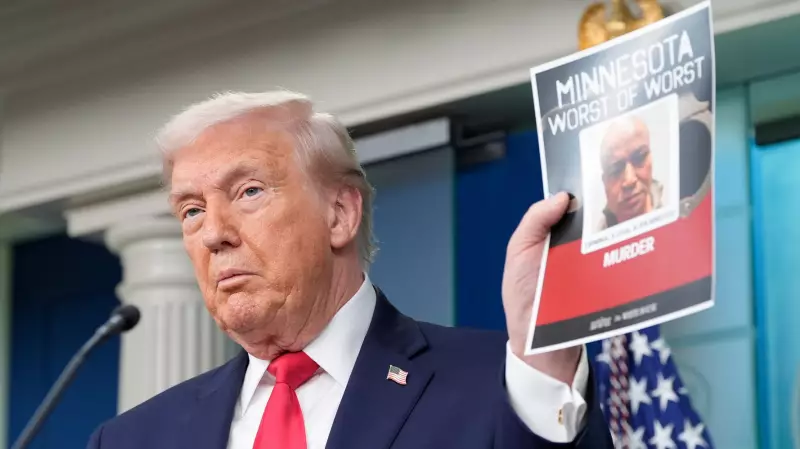
At a White House press briefing, Trump displayed photos of people ICE arrested in Minnesota while making disparaging comments about Somalia. "They don't have anything that resembles a country," Trump said. "They come here, and they become rich, and they don't have a job."
Michelmore identifies a consistent pattern: "They're telling a story about widespread criminal fraud in a particular racially identifiable group that then, because they're defined as inherently criminal, justifies this kind of a crackdown. They're not actually interested in welfare fraud. It's a way of talking about racial politics without using words and phrases you're no longer allowed to use in the post-1965 era."

The Evolution of Anti-Welfare Politics
Following Social Security legislation in the 1930s, newspapers began publishing stories about women cheating the Aid to Families with Dependent Children program. Throughout subsequent decades, media described welfare recipients hiding lovers, lying about poverty, and using benefits for luxury purchases.
Journalist Josh Levin, who wrote a book tracking anti-welfare politics from the 1930s, notes that "if there's a group that is already villainized, or that is a convenient scapegoat, then if you find a real example of fraud or a crime that's being committed, then it's just naturally going to get elevated."
The focus on fraud prompted dramatic increases in enforcement. Between 1970 and 1979, AFDC cases referred to law enforcement rose from 7,500 to over 52,000. In the 1990s, President Bill Clinton fulfilled his promise to "end welfare as we know it" by transforming AFDC from an open-ended cash benefit program to limited state grants.
Modern Fraud in a Changed System
Ironically, the government's shift toward service-based assistance rather than direct cash benefits created opportunities for fraud on a scale unimaginable to individual "welfare queens." Minnesota's fraudsters allegedly served as middlemen, billing for services never rendered in schemes totaling hundreds of millions.
Levin observes that "we're in this era where Trump is really pushing anti-immigrant rhetoric. And so, in each era, we get a variety of welfare scandal that fits the times." This pattern demonstrates how welfare fraud narratives consistently adapt to contemporary political climates while serving similar rhetorical purposes.
The Minnesota situation represents both continuity with past welfare politics and a dangerous escalation toward state-sanctioned violence, marking a new chapter in America's long history of using fraud stories to shape policy and public opinion.