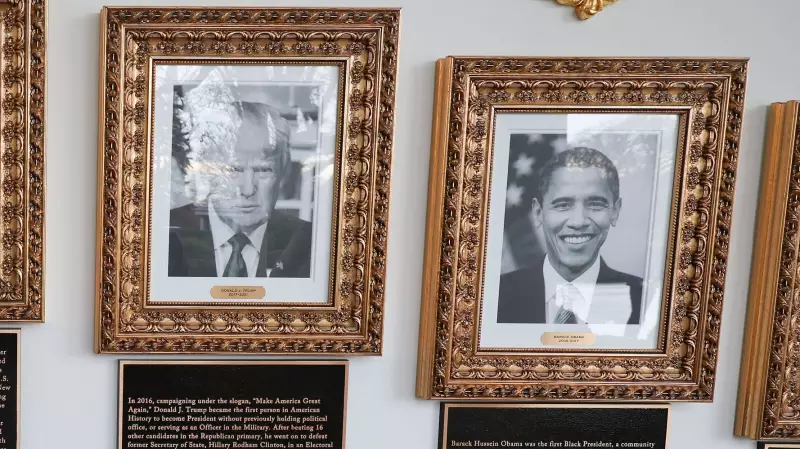
Former President Donald Trump ignited controversy this week with the addition of descriptive plaques to his "Presidential Walk of Fame" display at the White House. The new installations, featuring sharply partisan language and unconventional stylistic choices, have drawn swift criticism from historians who label them as unserious and politically charged distortions of history.
Content of the Controversial Plaques
The plaques, placed beneath portraits of most former presidents, are replete with inflammatory rhetoric and insults characteristic of Trump's communication style. The plaque for President Joe Biden, whom Trump lost to in the 2020 election, begins by calling him "by far, the worst President in American History." Notably, Biden's portrait is represented not by a traditional image but by a picture of an autopen and his signature, a reference to Trump's baseless attacks on the legitimacy of the previous administration.
Other entries offer a distinctly Trump-centric view of the past. President Barack Obama is referred to as "Barack Hussein Obama" and labelled "one of the most divisive figures in American history," despite contemporary polls showing he holds the highest favorability rating among living presidents. The plaque for President Gerald Ford suggests he "narrowly lost re-election to Jimmy Carter, probably because of his brave pardon of Richard Nixon."

President Ronald Reagan is described simply as "a fan of President Donald J. Trump," while President Warren G. Harding's plaque highlights his promise to "safeguard America first." The text also includes familiar Trump catchphrases and attacks, mentioning "the Biden Crime Family," "the Fake News Media," and "the highly ineffective 'Unaffordable' Care Act." The plaque for President Bill Clinton concludes by noting, "In 2016, President Clinton’s wife, Hillary, lost the Presidency to President Donald J. Trump!"
Historians Decry 'Politicized Commentary'
Academic experts were quick to pan the exhibits. Ellen Fitzpatrick, a professor of modern American political history, stated the plaques are "more White House decoration than anything else" and are definitively not serious history. "They reflect idiosyncratic and politicized commentary by the current president ― or whomever in his administration wrote the text ― on his predecessors," she told HuffPost.
This assessment clashes with the White House's own description. Press secretary Karoline Leavitt called the plaques "eloquently written descriptions" and claimed many were written directly by Trump, whom she termed "a student of history." Fitzpatrick countered that the reliance on superlatives like "worst" and "most corrupt" reveals the text fails to cross the threshold of credible historical analysis.
Michael Allen, an associate professor of U.S. political history at Northwestern University, offered a harsher critique. "The newly installed plaques are the equivalent of drawing mustaches on other people's portraits," he said. Allen emphasized that sitting presidents traditionally avoid such personal, partisan attacks on predecessors, both out of respect for the office and the understanding that historical judgment evolves over time. "With this act, President Trump violates that tradition, as he has many others," he added.
Political Strategy and 'Vibes-Based Polarization'
Some analysts see a calculated political motive behind the provocative displays. Mark Brockway, an assistant professor of political science at Syracuse University, described the plaques as "very much on brand" for Trump and a potentially effective, if ham-fisted, strategy.
"This is where Trump gets his power ― making liberals, or whoever he’s fighting, out to be evil or the worst or incompetent," Brockway explained. He noted the vague, superlative-laden language—such as declaring Biden the "worst president" without clear justification—allows supporters to project their own grievances onto the narrative. "The more vague and the more weird that enemy is, the more powerful Donald Trump becomes," he argued.

Brockway characterized this approach as "vibes-based polarization," feeding a narrative that "Democrats are outraged and coming for us! We need to fight them!" rather than engaging in substantive policy debate. He also pointed out that the plaques' lack of seriousness undermines the idea they are pure propaganda. "If they’re really trying to rewrite history, they would make it more serious," he said, suggesting Trump derives power from the conflict itself, not from erasing his predecessors.
The installation also appears to contradict Trump's own executive order, signed in March, titled "Restoring Truth and Sanity to American History," which directed federal agencies to remove "divisive" and "politicized" narratives from historical exhibits.
Ultimately, historians suggest the plaques reveal more about Trump than the presidents they purport to describe. Fitzpatrick noted that while presidents often critique predecessors, she knows of no other who mounted a similar exhibit in the White House. The act, she and others imply, reflects a deep fixation on legacy and historical perception—a concern no president can unilaterally control in a society with free expression of ideas.