

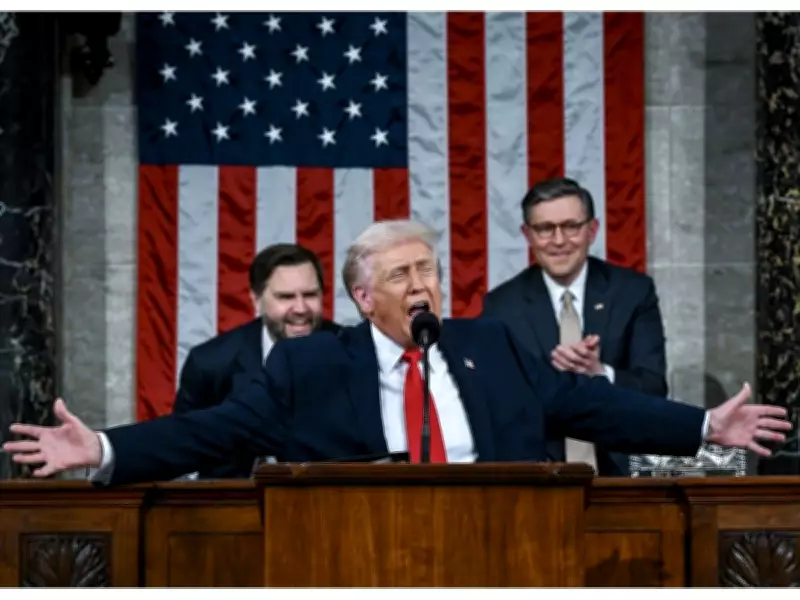
In a defiant display of political resolve, President Donald Trump utilized his State of the Union address to forcefully reaffirm his commitment to aggressive tariff policies, despite facing a significant legal setback from the Supreme Court just days earlier. The speech, delivered on Tuesday evening, served as a platform for the president to cast the American economy as robust and resilient in the lead-up to the midterm elections, which historically function as a referendum on a sitting president's popularity.
A Historic Address Amid Legal and Geopolitical Tensions
The State of the Union address, clocking in at a record one hour and forty-seven minutes, occurred against a backdrop of heightened tensions. The Supreme Court had recently struck down a major component of the administration's tariff strategy, while a U.S. military buildup in the Persian Gulf threatened Iran. President Trump addressed a joint session of Congress, with justices, military leaders, cabinet secretaries, and diplomatic officials seated before him.
Navigating a Supreme Court Rebuke
Though the Supreme Court's 6-3 decision invalidated the 35 percent tariff enacted under the International Emergency Powers Act, which Trump labeled as "very unfortunate," the president made clear he has no intention of retreating. "I will find alternative avenues to impose tariffs," he declared during the speech, showing more restraint than in previous remarks where he called the justices "unpatriotic."

Simultaneously, a new 10 percent tariff on most global imports took effect just after midnight on Tuesday, enacted under Section 122 of the Trade Act of 1974. This levy can remain for 150 days without congressional approval and largely exempts Canadian exports compliant with the Canada-United States-Mexico Agreement.
Enduring Impact on Key Industries
However, the most damaging tariffs from the Trump era remain untouched by the court's ruling, as they were imposed under different legal mechanisms. These include 50 percent levies on aluminum and steel imports from Canada and 25 percent duties on vehicles not manufactured in the U.S., with limited exemptions for CUSMA-compliant vehicles. These policies have significantly impacted automotive and manufacturing sectors in regions like Windsor-Essex.
"I haven't seen anything that would indicate that he won't pursue more tariffs," stated Jeff Rightmer, an automotive supply chain expert and professor at Wayne State University, highlighting ongoing uncertainty for affected industries.
Presidential Power and Trade Policy Autonomy
Analysts point to the president's ability to act unilaterally as a key driver of his persistent tariff strategy. "I think the thing that keeps him going on this track is that he can just do it himself," explained Peter Frise, a professor of automotive and mechanical engineering at the University of Windsor. "He doesn't have to talk to Congress. He doesn't have to persuade senators and congressmen. He can just sit in the oval office and talk to a microphone and say, 'Those guys did something I didn't like, so I'm going to put a tariff on that.'"
This executive autonomy allows Trump to swiftly implement trade measures, bypassing lengthy legislative processes and maintaining a consistent, aggressive stance on international trade.
Economic and Political Implications
The timing of the address is particularly significant, as the president seeks to bolster his economic narrative ahead of the midterm elections. By emphasizing strength and resilience, Trump aims to shape public perception and secure political support despite ongoing legal challenges and international tensions.
The speech underscored a clear message: regardless of judicial pushback, the administration remains steadfast in its trade policy approach, leveraging available legal mechanisms to sustain and potentially expand tariff measures. This unwavering position continues to create ripple effects across global supply chains, diplomatic relations, and domestic industries, setting the stage for further economic and political developments in the coming months.






