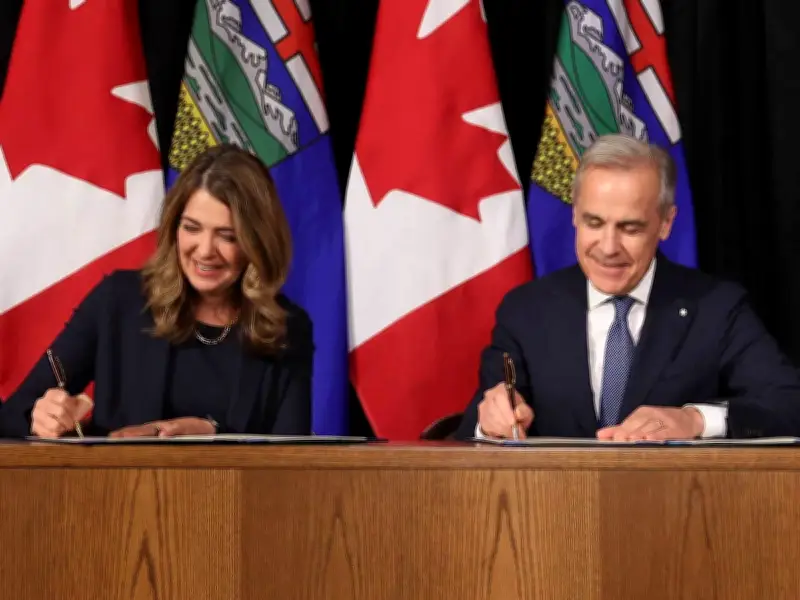
Prime Minister Mark Carney has pledged to use the summer months to make the case for Canada and convince Albertans that the federal government is a willing partner, but skepticism persists as actions have yet to match ambitious rhetoric.
Speaking at his end-of-sitting news conference last week, Carney vowed to demonstrate that things are improving for Alberta, a province that has long felt at odds with Ottawa. However, as Rob Breakenridge notes in the Calgary Herald, actions speak louder than words.
A Year of the Building Canada Act
The Building Canada Act, which created the Major Projects Office, marked its first anniversary last week. The legislation was rushed through with promises of building big and building quickly. Yet, until recently, no project had been declared in the national interest and placed on the new fast track.

Last week, the first three projects were finally designated: the Mackenzie Valley Highway Project in the Northwest Territories, the Grays Bay Road and Port Project in Nunavut, and a nuclear waste storage project in northwestern Ontario. While these are worthwhile, Breakenridge calls it an underwhelming return for what was billed as transformational.
Pipeline Proposal on the Horizon
This week, a West Coast oil pipeline project proposal is expected to be submitted to the Major Projects Office. The hope is that it could receive a national interest designation by October—a much faster timeline than previous projects. The agreement between Alberta Premier Danielle Smith and Prime Minister Carney, signed in Calgary on May 15, 2026, paved the way for this development.
“Ultimately, as they say, actions speak louder than words,” Breakenridge writes. “The original MOU between Alberta and Ottawa, and the subsequent agreement on how to proceed, would both fall into that category, even if they’re smaller steps on a path to a larger outcome.”
Skepticism Remains
Carney is unlikely to win over committed separatist voters, while Liberal supporters in Alberta—now a less lonely group—probably need little convincing. The broader challenge is proving that the federal government can accelerate major projects efficiently.
“Getting to those larger outcomes is where the federal response is still lacking,” Breakenridge notes. “Hopefully, part of the prime minister’s summer will involve a focus on how to accelerate those paths, because it’s been underwhelming thus far.”
The optimistic view is that, having reached this milestone, subsequent announcements will flow more quickly. But the underlying problem remains: that such a process was necessary in the first place.