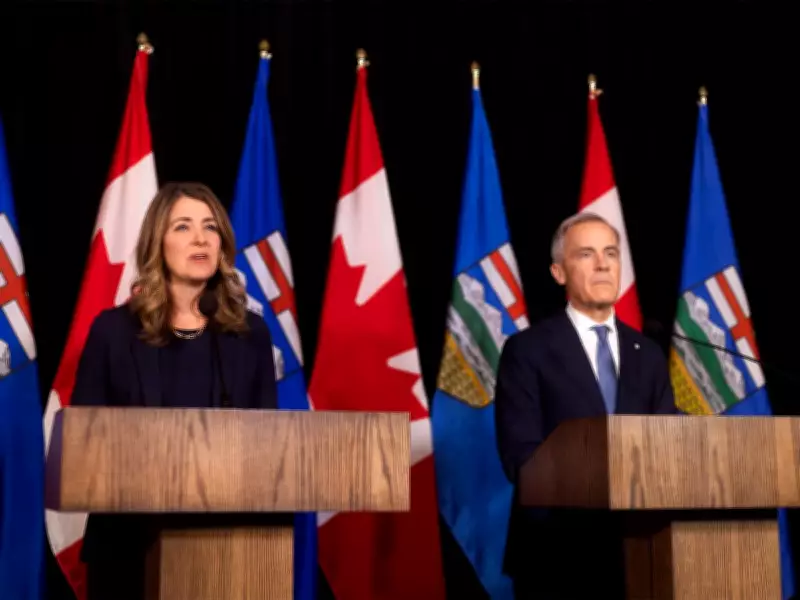
Prime Minister Mark Carney should be the last person to lecture Premier Danielle Smith on the merits of Canadian democracy, argues Chris Nelson in a recent column for the Calgary Herald. Carney has been criticizing Smith for allegedly running roughshod over Albertans' democratic rights, but Nelson points out the irony given Carney's own political ascent.
Carney's Hypocrisy
Nelson reminds readers that Carney became prime minister without a federal election, after the Liberal party decided Justin Trudeau was a liability. Carney was parachuted in as leader and only called an election months later, after crafting a persona as a strong leader standing up to U.S. President Donald Trump. Even then, Carney failed to secure a majority, relying on backroom deals with Conservative MPs who crossed the floor to give the Liberals enough seats to govern.
Carney recently questioned the democratic will of Albertans regarding separatism, noting that the 2023 provincial election did not feature the question of Alberta leaving Canada. He stated, "Is this the democratic will of Albertans? Did they vote for this in the last provincial election? No, they didn't. It wasn't on the ballot, wasn't in the mandates or the platforms of any of the governing party and the official Opposition."

Smith's Precarious Position
Meanwhile, Smith is fighting for her political survival as the separatist movement within her party intensifies. She has alienated a wide range of groups, including separatists, federalists, the opposition, Indigenous leaders, constitutional lawyers, other premiers, Calgary's mayor, and the chamber of commerce. Carney appears to be capitalizing on Smith's vulnerability, sensing an opportunity to gain political points across Canada.
Smith has attempted to use the threat of separatism as leverage against a federal government that has repeatedly insulted Alberta. However, this strategy has proven risky, and she has now unequivocally declared her support for Canada. Given the makeup of her party, this enthusiastic nationalism is likely to cause further turmoil.
The Pipeline Question
Nelson raises the question of whether Alberta would be close to getting a new oil pipeline to the West Coast without Smith's efforts. He suggests that Smith's aggressive stance may have been instrumental in advancing Alberta's interests, even if her methods have been controversial.
As Carney moves on, likely to pursue a top job with the EU or IMF after his prime ministerial term, Smith's future remains uncertain. She continues to navigate a complex political landscape, balancing the demands of separatists within her party with the need to maintain support from federalists and the broader Canadian public.