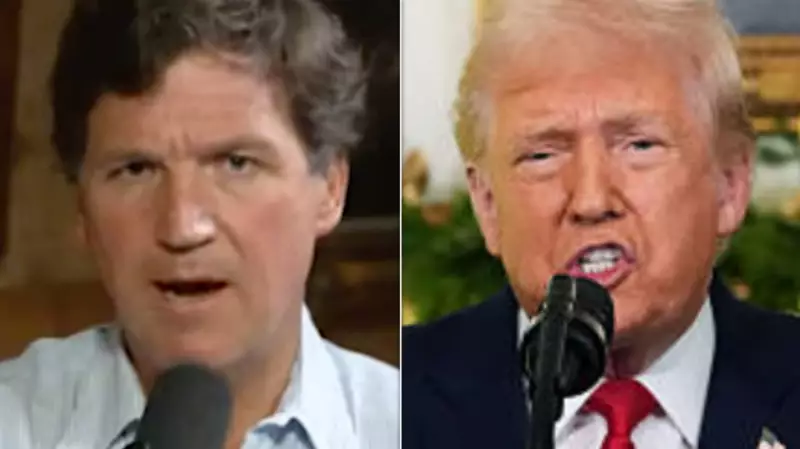
In a significant and embarrassing misfire, former Fox News host Tucker Carlson incorrectly forecast that President Donald Trump would use a prime-time address to declare war against Venezuela. The prediction, which did not come to pass, has sparked widespread mockery and fueled a flurry of online conspiracy theories.
The Failed Prediction and Its Source
The speculation originated during Carlson's appearance on the "Judging Freedom" podcast with Andrew Napolitano on Wednesday, December 18, 2025. Carlson claimed he had received a tip from a member of Congress.
"Here’s what I know so far, which is that members of Congress were briefed yesterday that a war is coming and it’ll be announced in the address to the nation tonight at 9 o’clock by the president," Carlson stated. He added a cautious hedge, saying, "Who knows, by the way, if that will actually happen. I don’t know... but a member of Congress told me that this morning."

This claim was made against a backdrop of heightened tensions. The Trump administration had recently escalated legally questionable actions against alleged Venezuelan drug-smuggling boats and even seized a Venezuelan oil tanker, lending a superficial plausibility to the war rumor.
Reaction and Ridicule from Officials and Public
When President Trump's speech concluded without any mention of Venezuela, the reaction was swift. Senator Ruben Gallego, a Democrat from Arizona, took to X (formerly Twitter) to note the absence of the predicted announcement.
"Well at least @potus didn’t announce we are going to war in Venezuela," Gallego wrote. "No clue what was the purpose of the speech."
Online, critics and commentators aimed direct taunts at Carlson for the erroneous report. One MAGA supporter posted a video of Carlson making the claim with the caption, "Imagine being this wrong." Another user quipped, "So much for the brilliant Tucker Carlson." The mockery was encapsulated in a Homer Simpson meme shared by user Jason Buttrill, visually summarizing Carlson's perceived embarrassment.
Conspiracy Theories and Alternative Explanations
Beyond simple mockery, Carlson's incorrect report led some observers to propose more elaborate explanations. Several online posts suggested the episode was a deliberate disinformation campaign orchestrated by Trump or his allies.
One theory posited that Carlson was used, either knowingly or unknowingly, in a "masterfully orchestrated" head fake. The goal, according to this narrative, was to trick major news networks into airing a recap of Trump's first-year accomplishments during prime time, thereby manipulating media coverage.
Ryan Grim of Drop Site News, a former HuffPost staffer, offered a different possibility. He questioned whether Trump had simply decided against announcing "whatever insanity he was planning," implying the prediction may have been based on real but abandoned plans.
The incident highlights the volatile nature of political reporting and the rapid spread of unverified claims in the modern media landscape. It also underscores how such claims can quickly morph into broader narratives about media manipulation and political strategy, regardless of their factual basis.