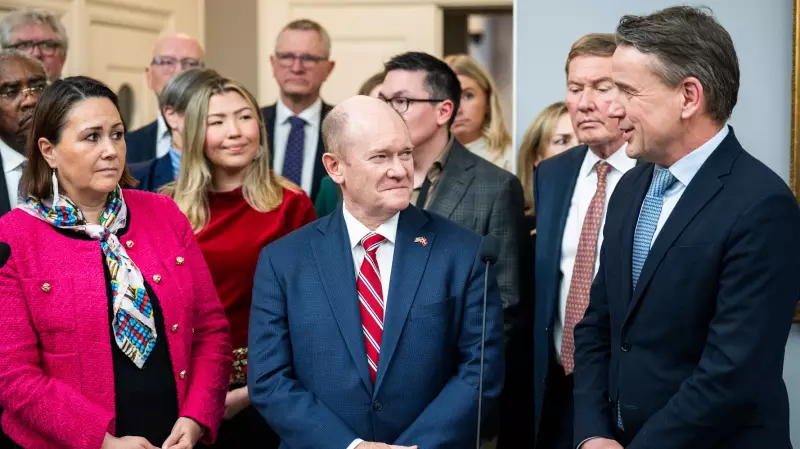
A high-level bipartisan delegation from the United States Congress arrived in Copenhagen on Saturday with a clear mission: to calm fears and reaffirm support for Denmark and Greenland following President Donald Trump's recent threats to impose tariffs if the U.S. is not allowed to take over the strategic Arctic island.
Delegation Aims to De-escalate Arctic Tensions
Led by Senator Chris Coons, a Democrat from Delaware, the delegation acknowledged the deep concern caused by the White House's rhetoric. "I hope that the people of the Kingdom of Denmark do not abandon their faith in the American people," Coons stated during a press conference at Christiansborg Palace on January 16, 2026. He emphasized the United States' respect for Denmark and their shared history within NATO, framing the visit as an effort to demonstrate strong bipartisan congressional support for a key ally.
This conciliatory message stood in stark contrast to the position emanating from Washington. President Trump has repeatedly justified his push for U.S. control of Greenland by citing the territorial ambitions of China and Russia, pointing to the island's vast reserves of critical minerals. The White House has notably not ruled out acquiring the territory by force. In response, Coons sought to directly counter this narrative, asserting, "There are no current security threats to Greenland."

Public Protests and Diverging Narratives
As the politicians met, thousands of demonstrators marched through the streets of Copenhagen in a show of solidarity with Greenland. Many carried the Greenlandic flag, while others held signs with messages like "Make America Smart Again" and "Hands Off." A similar rally was planned in Nuuk, Greenland's capital, highlighting the strong public sentiment against the proposed takeover.
The diplomatic rift widened earlier in the week when Trump, during an event on rural healthcare, explicitly linked tariffs to the Greenland issue. "I may put a tariff on countries if they don’t go along with Greenland, because we need Greenland for national security. So I may do that," he declared on Friday, January 15. This marked the first time he had proposed using trade penalties to force the matter.
Despite a meeting in Washington between the foreign ministers of Denmark and Greenland with U.S. Vice President JD Vance and Secretary of State Marco Rubio, significant disagreements remain. The parties agreed to establish a working group, but publicly offered sharply different interpretations of its purpose.
Broader Implications for NATO and Alliances
Senator Coons framed the situation as a critical test of American reliability. "There is almost no better ally to the United States than Denmark," he argued. "If we do things that cause Danes to question whether we can be counted on as a NATO ally, why would any other country seek to be our ally or believe in our representations?" His comments underscore the potential long-term damage to America's global partnerships.
In a firm response to the U.S. posture, Denmark announced this week that it is increasing its military presence in Greenland, doing so in cooperation with allies. European leaders have unanimously insisted that matters concerning Greenland's sovereignty are to be decided solely by Denmark and Greenland itself.
The two-day congressional visit highlights the profound gap between the legislative branch's desire to maintain strong transatlantic ties and the executive branch's unilateral approach to Arctic security, leaving a key NATO alliance under unprecedented strain.