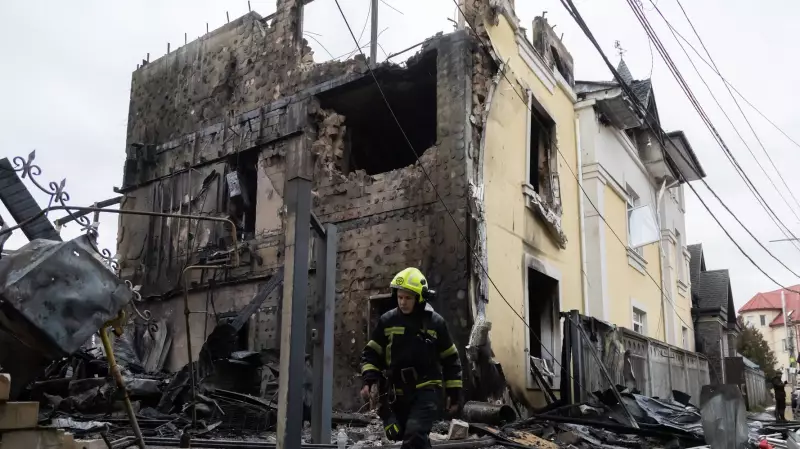
In a major escalation ahead of critical diplomatic talks, Russian forces launched a large-scale assault on Ukraine's capital of Kyiv early Saturday. The attack, involving a barrage of ballistic missiles and drones, resulted in at least one fatality and left 27 people wounded, according to Ukrainian authorities.
A Prolonged Assault on the Capital
The offensive began in the early morning hours, with explosions reverberating across Kyiv for several hours. Ukraine's air force reported that Russia used a total of 519 drones and 40 missiles in the nationwide attack, with the capital being a primary target. The Russian Defense Ministry claimed it carried out a "massive strike" using long-range precision weapons from land, air, and sea, including advanced Kinzhal hypersonic missiles. It stated the targets were energy infrastructure and military-industrial sites, but multiple residential buildings were struck.
Ukrainian Interior Minister Ihor Klymenko confirmed that more than 10 residential buildings were damaged. In the Dniprovskyi district, an 18-story residential building was severely damaged, with a fire breaking out. A 24-story building in the Darnytskyi district was also hit. Tymur Tkachenko, head of the Kyiv Military Administration, said the attack impacted seven locations across the city, with two children among the wounded.

The human toll was starkly illustrated by Olena Karpenko, 52, who described hearing a man burn to death after a strike. "His scream is still in my ears. I can't believe it," she said, weeping. A body was later found in the rubble of one damaged building.
Timing Before High-Stakes Diplomacy
The assault occurred just one day before Ukrainian President Volodymyr Zelenskyy is scheduled to meet with U.S. President Donald Trump in Florida on Sunday. The leaders plan to discuss security guarantees, territorial issues, and a potential roadmap to end the nearly four-year conflict.
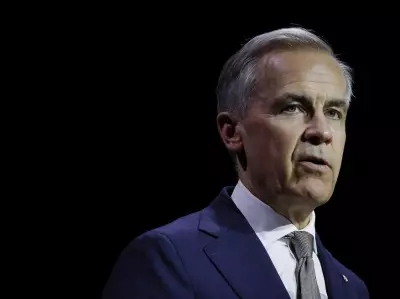
Speaking to reporters after a stop in Canada, Zelenskyy framed the attack as a deliberate signal from Moscow. "This attack is Russia's answer on our peace efforts. It really shows that (Russian President Vladimir) Putin doesn't want peace," he stated. During his visit to Halifax, Nova Scotia, Canadian Prime Minister Mark Carney announced a new $1.8 billion economic assistance package for Ukraine, designed to unlock further financing from the International Monetary Fund and World Bank.
"The barbarism that we saw overnight, the attack of Kyiv, shows just how important that we stand with Ukraine during this difficult time," Carney emphasized.
Regional Escalation and Russian Claims
In what appeared to be a coordinated pressure campaign, the Kremlin released a video on Saturday night showing Putin in military fatigues receiving reports from top commanders. Russia's General Staff chief, Gen. Valery Gerasimov, reported to Putin that Russian troops had taken full control of Myrnohrad in Donetsk and Huliaipole in Zaporizhzhia, among other settlements. Ukrainian officials did not immediately confirm these claims, though Ukraine's General Staff reported repelling enemy attempts to advance in several areas.
Putin warned, "if Kyiv authorities are not willing to end the matter peacefully, we will achieve all the goals we have in the special military operation by military means."
The attack also triggered a security alert in neighboring Poland, which scrambled fighter jets and temporarily closed airports in Lublin and Rzeszow near the Ukrainian border. Polish authorities confirmed no airspace violation occurred.
The strikes caused significant damage to energy infrastructure. Ukraine's largest private energy company, DTEK, reported "extensive power outages" in Kyiv, leaving hundreds of thousands of customers without electricity. President Zelenskyy confirmed that some districts were left without power or heating.
As Zelenskyy prepares for his crucial meeting with President Trump, he indicated that securing clear security guarantees for Ukraine would be a top priority. He reiterated that Ukraine would "never recognize any territory as Russian under any circumstances," setting the stage for complex negotiations on the status of occupied regions like Donetsk and Zaporizhzhia.