

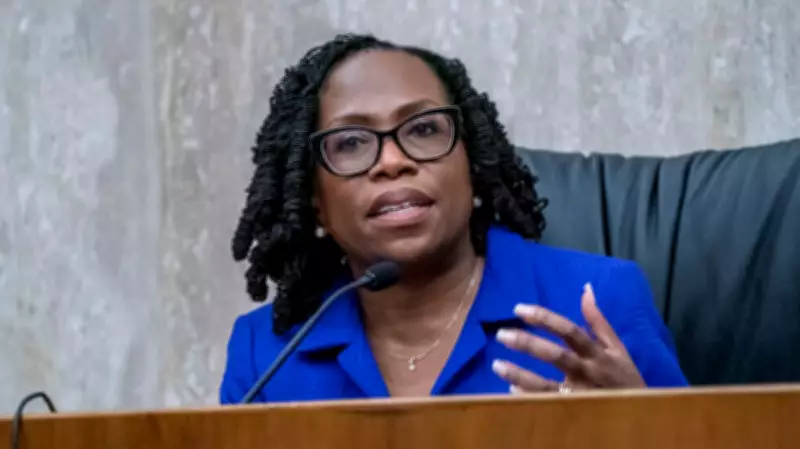
Justice Jackson Delivers Scathing Critique of Supreme Court's Emergency Orders
Supreme Court Justice Ketanji Brown Jackson has launched a sustained attack on her conservative colleagues' use of emergency orders to benefit the Trump administration, labeling these orders as "scratch-paper musings" that can "seem oblivious and thus ring hollow." In a detailed assessment, Jackson highlighted roughly two dozen court orders issued last year that allowed President Donald Trump to implement controversial policies on immigration, steep federal funding cuts, and other areas, despite lower courts deeming them likely illegal.
Emergency Orders as Short-Term Solutions with Long-Term Impacts
While these emergency orders are designed to be temporary, they have largely enabled Trump to advance key parts of his sweeping agenda for the time being. Jackson spoke for nearly an hour at Yale Law School, with the event video posted on Wednesday, emphasizing that these orders often come with little or no explanation, resembling "back-of-the-envelope, first-blush impressions of the legal issue." She argued that the court's insistence on applying these hasty decisions in other cases exacerbates the problem.
Failure to Acknowledge Real-World Consequences
Jackson pointed out an additional flaw: the orders' failure to acknowledge the real people affected, making them appear disconnected and hollow. She also challenged the court's view that preventing the president from enacting a policy constitutes a harm that outweighs the challenges faced by opponents. "The president of the United States, though he may be harmed in an abstract way, he certainly isn't harmed if what he wants to do is illegal," Jackson stated during a question-and-answer session with law school dean Cristina Rodriguez.

Shift in Judicial Restraint and Public Advocacy
Reflecting on historical practices, Jackson noted that the court used to be reluctant to intervene early in legal processes, valuing restraint to avoid divisive policy issues. However, she observed a recent change, saying, "in recent years, the Supreme Court has taken a decidedly different approach to addressing emergency stay applications. It has been noticeably less restrained, especially with respect to pending cases that involve controversial matters." Jackson, often joined by Justices Sonia Sotomayor and Elena Kagan in dissents, has engaged in internal conversations about these orders but chose to speak publicly to act as "a catalyst for change."
Broader Context and Apology from Justice Sotomayor
This critique follows similar remarks by Justice Sonia Sotomayor last week at the University of Alabama, where she also took issue with the conservatives' approach to emergency orders. In a related development, Sotomayor issued a rare public apology to Justice Brett Kavanaugh for "hurtful comments" made during an appearance at the University of Kansas law school, referencing an opinion Kavanaugh wrote in an immigration case involving an emergency order sought by the administration.
Jackson's public address at Yale Law School marks a notable departure from her previous criticisms in dissenting opinions and private discussions, aiming to spark broader dialogue and reform within the judicial system regarding the use of emergency orders.






