

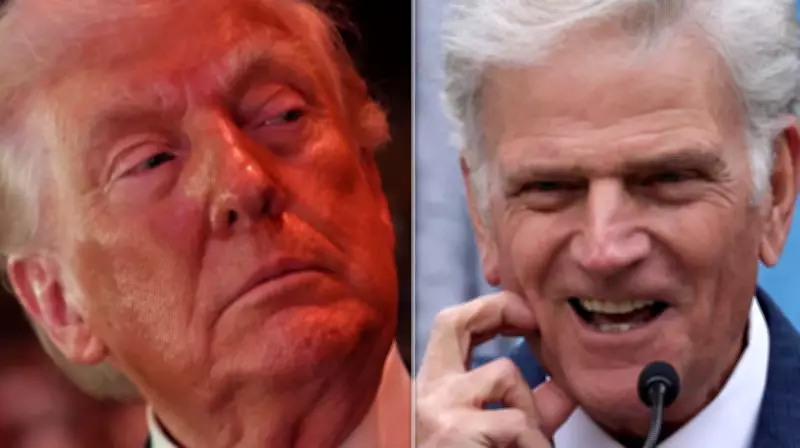
Franklin Graham's Defense of Trump's AI Image Ignites Controversy
On Thursday, Franklin Graham, the prominent evangelist and longtime ally of former President Donald Trump, took to social media platform X to vigorously defend Trump's posting of an AI-generated image that depicted him in a Jesus-like manner earlier in the week. Graham asserted that he did not believe Trump would "knowingly depict himself as Jesus Christ" and expressed gratitude that Trump had clarified the image was intended to show him as a doctor "helping someone."
Image Details and Immediate Backlash
The controversial image, which Trump shared on his Truth Social platform, portrayed him wearing white and red robes with light emanating from one hand while apparently healing a sick individual. The post faced swift condemnation from religious leaders and individuals across the political spectrum, including some of Trump's most vocal supporters. In response to the backlash, Trump removed the photo and later claimed he interpreted it as depicting him in a medical role.
Graham's Unwavering Support
Despite widespread criticism and mockery of Trump's explanation, Graham offered a staunch defense on X. He argued that the image contained no overt spiritual symbols such as halos, crosses, or angels, instead featuring elements like flags, soldiers, and eagles. "There is so much ill-intended speculation," Graham wrote. "I think his enemies are always foaming at the mouth at any possible opportunity to make him look bad."

Graham further defended another post Trump shared on Wednesday featuring an image of Jesus embracing him, stating, "I must say that I like the fact that this is a picture of Jesus whispering in his ear, or at least His hand on his shoulder, guiding him. We all need that — we all need to be listening to Jesus." He concluded by praising Trump as "the most pro-Christian, pro-life president in my lifetime, and he doesn't shy away from it."
Scholarly Criticism and Theological Concerns
Deepak Sarma, inaugural distinguished scholar in the public humanities at Case Western Reserve University, provided a critical analysis of Graham's statements. Sarma suggested that Graham's defense "highlights how certain expressions of MAGA Christianity have drifted, both conceptually and ethically, from the core of the Christian tradition." He elaborated that this approach prioritizes loyalty over moral discernment and may even celebrate blasphemous behavior.
Sarma, who holds a Ph.D. in the philosophy of religions from the University of Chicago Divinity School, noted that Graham's remarks mirror Trump's rhetorical tactics of deflection and revision. "Graham's remarks closely track Donald Trump's familiar rhetorical patterns: deflection, revision, and the redistribution of responsibility onto the audience — classic gaslighting," Sarma explained. He described Trump's doctor explanation as "retroactive meaning-making" and "textbook narrative manipulation," emphasizing the troubling implication that any misinterpretation lies with the audience rather than the act itself.
Political Reactions and Historical Context
The response on social media was sharply divided. Former Representative Marjorie Taylor Greene expressed dismay, writing, "Franklin Graham of all people, who is frequently at the White House and with Trump, should be leading Trump to be a Christian, NOT telling other Christians that Trump did nothing wrong when he committed blasphemy."
This incident is not the first time Graham's support for Trump has drawn criticism. In 2021, he compared Republicans who voted to impeach Trump for inciting the Capitol riot to Judas Iscariot. He has also publicly questioned the legitimacy of the 2020 election results. During Trump's inauguration prayer last year, Graham remarked, "Mr. President, the last four years, there are times I'm sure you thought it was pretty dark. But look what God has done." William Willimon, a United Methodist Church bishop and professor at Duke Divinity School, previously described such comments as "divisive" and "political."

Broader Implications for Faith and Politics
Sarma concluded that Graham's defense reflects a broader dynamic where "affirmation sustains belonging and dissent carries cost." He observed that even influential figures seem reluctant to challenge prevailing narratives, noting, "Some MAGA and non-MAGA Christians are seeing Graham's defense of Trump for what it is: a poorly veiled attempt to curry favor with Trump and also to maintain status as a high profile faith leader."
This episode underscores ongoing tensions between theological principles and political allegiance within certain Christian circles, raising questions about the intersection of faith, power, and public discourse in contemporary America.





