Survival Experts Reveal 10 Essential Gear Items for Safe Camping Adventures
Safety and emergency preparedness are fundamental considerations for any camping or outdoor excursion. However, many outdoor enthusiasts may overlook the importance of regularly auditing their gear inventory or learning essential items if they are new to wilderness activities. According to Cody Lundin, an Arizona-based survival instructor specializing in primitive living skills and urban preparedness, the specific gear one should carry depends heavily on several factors.
"The essential gear a person takes outdoors is really based upon their bioregion, the intention of the trip, personal skill level, and experience," Lundin explained. "For instance, if I head into mountains with spruce and fir trees versus one of North America's four deserts, the gear I carry adapts to that specific landscape. Winter survival and desert survival represent opposite temperature extremes that can prove fatal to unprepared hikers or campers."
Despite these variations, Lundin notes that certain items have been carried by indigenous peoples for millennia and remain valid in modern outdoor survival kits. Once you have your tent, sleeping bag, and snacks ready, consider this expert-curated list of ten items that Lundin and other wilderness professionals always bring into the field, along with guidance for making your next camping trip both safe and enjoyable.

1. Emergency Bivy Sleep Sack
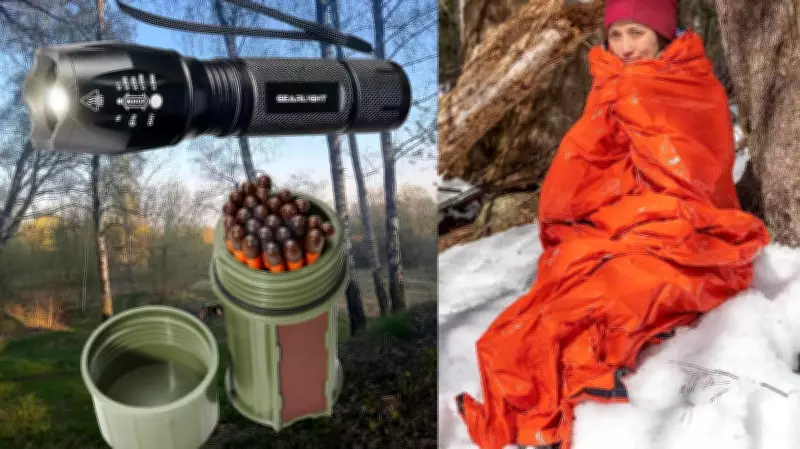
Author and emergency prepping expert M.D. Creekmore recommends an emergency bivy sleep sack, which differs from traditional sleeping bags by being ultra-compact, lightweight, and engineered to retain body heat efficiently. "It's perfect for unexpected overnight stays in the wilderness, providing crucial warmth and shelter without adding much bulk to your kit," Creekmore said. An affordable, highly-rated option includes a rescue whistle and tinder cord, featuring 90% heat reflectivity with wind- and waterproof properties. It packs down to roughly the size of a soda can.
2. Stormproof Strike-Anywhere Matches and Match Safe
Survival instructor Cory Lundin emphasized the critical role of fire in survival scenarios and the need for reliable, modern lighting tools. "I prefer a gross motor way to create fire, meaning it's easier to do when stressed, with cold hands, or in inclement weather," Lundin stated. "Save exotic fire-by-friction sets for entertainment or demonstrations." Lundin carries at least three different fire-lighting methods in his personal kit due to varying pros and cons. One method involves strike-anywhere matches stored in a match safe. A recommended set includes 25 storm- and wind-proof matches that burn up to 15 seconds each, can relight after submersion, and come in a floating, waterproof matchbox with an integrated, replaceable striker.
3. Tactical LED Flashlights
Flashlights should be standard tools for camping, according to experts. Compact, weather-proof tactical LED flashlights with high lumens are ideal, featuring five light modes, a zoomable beam, and durability to withstand a 10-foot drop. Their affordability and over 70,000 five-star ratings make them a popular choice.
4. Ferro Rod Fire Starter
Recommended by both M.D. Creekmore and Cody Lundin, a Ferro Rod with striker is a magnesium bar with an embedded ferrocerium rod as an ignition source. The sharp-toothed sparker shaves off hot magnesium ribbons to easily light tinder. Creekmore advises packing cotton balls dipped in petroleum jelly alongside the Ferro Rod, as they serve as effective tinder and sustain burning longer.
5. Two-Way Emergency Satellite Phone
Mykel Hawke, a former Army special forces officer and survival expert, highlights communication as the top priority in emergencies. "I recommend a satellite phone or spot device for areas with no cell coverage," Hawke said. Satellite phones enable users to send SOS notifications to global 24-hour search and rescue services and share locations with loved ones, though an active subscription is required. Features include an accurate compass, directional routing, Bluetooth syncing with smart devices, and battery life up to 14 days per charge. Reviewers note that message response delays may occur.

6. Editor-Endorsed Sleeping Pad
While not always considered a safety essential, Hawke stresses that quality sleep is undervalued outdoors, and poor rest can ruin a camping trip. Although Hawke didn't specify a brand, a highly-rated self-inflating pad uses air-channeled foam insulation for lightweight comfort and warmth in cold conditions, available in various sizes.
7. Credit Card-Sized Fresnel Lenses
Lundin's final fire-starting tool is a pack of three credit card-sized Fresnel lenses, which use magnification to concentrate sunlight onto tinder for ignition. "All fire craft demands reasonable skill and attention," said Lundin, who teaches fire safety courses. He cautions that hundreds of wilderness acres are lost annually to forest fires caused by careless campers lacking fire knowledge.
8. All-Purpose Emergency First Aid Kit
Hawke notes that first aid kits are surprisingly often forgotten despite being a camping essential. A comprehensive kit should address both illnesses and injuries. A popular 299-piece option includes supplies for disinfecting wounds, bandaging cuts, and soothing burns, with clear compartments and a soft-sided zip case for organization and portability.
9. Robust Knife with Continuous Blade
Creekmore praises a robust, full-tang knife for survival tasks like cutting, carving, and game processing. "Its durable build and sharp edge make it reliable for any wilderness adventure," he said. Lundin advises choosing a fixed carbon steel blade with a wide sharpening bevel and simple design. "The skill comes from the user, not the knife, and a simple blade offers the most versatility across environments," Lundin explained.
10. Multi-Fuel Camping Stove
Hawke recommends a good camp stove and utensils for cooking, boiling, and cleaning. "The main thing we do is cook, boil, eat, drink, prep, clean, and repeat, so own good stuff," he said. He personally uses multi-fuel stoves to maintain ignition flexibility. A well-known hybrid portable stove operates with canister fuel, white gas, kerosene, and unleaded gasoline, featuring technology for optimal fuel-air mix and consistent performance in cold weather or low-fuel conditions.