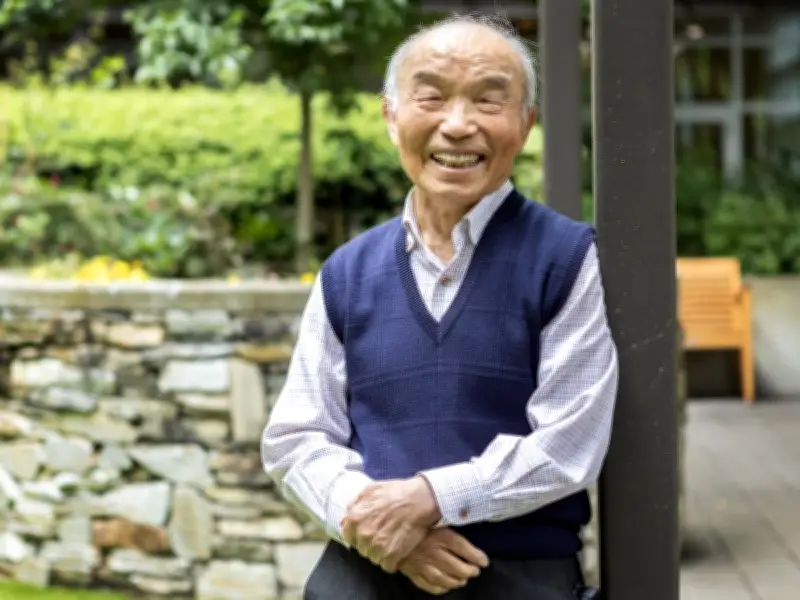
At this year's BMO half-marathon in Vancouver, Yul Kwon won his category with a time of 3:50:33. He also came in last. That's because he was the only runner in the 90-plus division.
Until this year, marathon categories ended at the 85-89 age group. Kwon, who is 90, wrote to organizers to add a new category. They agreed.
"It would be unfair for someone in their 90s to race against someone in their 80s," he joked.

Running as a Source of Joy
Kwon beams like a kid when he talks about running. "Happiness is my priority now," he says. "At my age, I can see the end of my life. It's important to cherish every moment."
Running, a hobby he took up at 60, is part of that. At 80, he won his age group in the Boston marathon.
Life at the Retirement Community
In the lobby of Seasons Wesbrook Village Retirement Community near UBC, a woman stops him to talk. Kwon, a retired economics professor, is a celebrity there. He has been nominated for the "remarkable residents" honour.
"Running is hard," he says. Moving through discomfort brings rewards, including joy. He runs because he can.
Overcoming a Difficult Past
Kwon wears clean New Balance sneakers, neatly tied. Born to impoverished farmers in a village on Korea's southern peninsula, he had no shoes until he learned to weave his own from rice straw.
The rice his family harvested was allocated to Japanese colonial occupiers. There was no running water or toilet. Kwon felt shame about his distended belly, swollen from starvation and parasites.
He was one of nine children. Three did not survive infancy. "Somehow I survived."
Education and War
His parents scraped together money to send him to elementary and middle school in Masan, something his siblings did not get to do. His best hope was working in an office, not fields.
But the North Korean invasion on June 25, 1950, ended his schooling. He returned home. "I was too young to be drafted." His village was caught in months of bombardment. His mother was killed, and the family displaced.
After the war, his father had no money for school. Kwon ran away. His sister-in-law sewed him a backpack with textbooks and dry rice. On the 20-kilometre walk back to Masan, he saw devastation. "There was nothing left. All the villages were burned."
He began studies again, peddling newspapers to support himself. "I was so lonely."
Finding Purpose Through Running
Kwon's journey from poverty and war to marathon runner is a testament to resilience. "I learned diligence, perseverance," he says. Running gives him comfort and purpose. At 90, he continues to inspire others with his determination and joy.