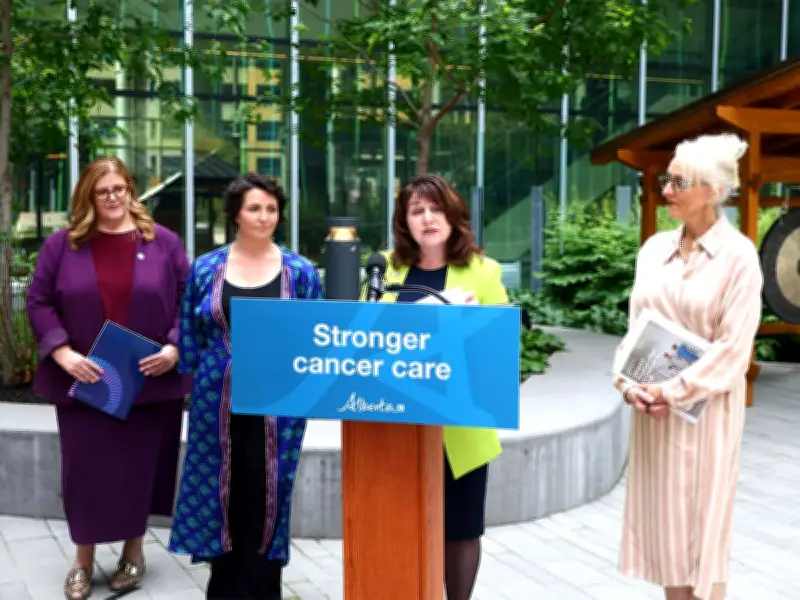
Alberta has introduced a 10-year strategy for cancer care aimed at improving detection, wait times, equipment, treatment, and the use of artificial intelligence to aid clinical decisions. However, the plan does not include new or additional funding.
Four pillars of the strategy
The strategy is built on four key pillars: screening, patient experience, research and innovation, and workforce development. Minister of Hospital and Surgical Services Adriana LaGrange emphasized that this is not a static document. “This is not a government document sitting on a shelf,” she said during a news conference on Tuesday. “It is a long-term plan grounded in evidence and shaped by the voices of patients.”
Screening expansion and wait-time targets
The strategy aims to expand screening services across the province, particularly in rural and Indigenous communities, through mobile facilities such as the screen test mobile mammography service, which already serves more than 120 communities and 28 Indigenous communities. The government also set a target to meet its provincially established wait-time goal for 90 per cent of cancer patients by 2030. Currently, patients wait an average of 13 weeks to see an oncologist in Alberta, more than three times the province’s goal of four weeks.

Investment in equipment and workforce
LaGrange stated that the province will invest in more equipment, facilities, and staff. The strategy also includes expanding access to advanced therapies and increasing clinical trials and research, conducted in partnership with Siemens Healthineers and the Alberta Cancer Foundation. Last year, the province announced an $800-million capital investment to replace aging equipment—65 per cent of treatment equipment was past its life cycle—and to build two centres: one focused on oncology training and another on artificial intelligence and machine learning. Siemens Healthineers, a German company, committed $175 million to the project and also provides software consulting to Alberta.
Funding questions
When asked about specific funding for the strategy, LaGrange referred to the $1.2-billion budget for Cancer Care Alberta, a separate health-care agency spun out of Alberta Health Services. However, Brenda Hubley, managing director at Cancer Care Alberta, later clarified that “there hasn’t been additional new funding specific to the strategy.” She added that some priorities are being funded through the 2026 budget allocation. “It’s through our regular 2026 budget that we will be allocating additional resources to support initiatives that are aligned with the strategy. Not every component of the strategy needs to be something brand new that hasn’t been thought of or that we haven’t already resourced.” In February, the province allocated $223 million to Cancer Care Alberta over three years, bringing its total budget to $1.2 billion. The agency will use these funds to hire additional oncologists, expand surgical capacity, and complete renovations at the Cross Cancer Institute.