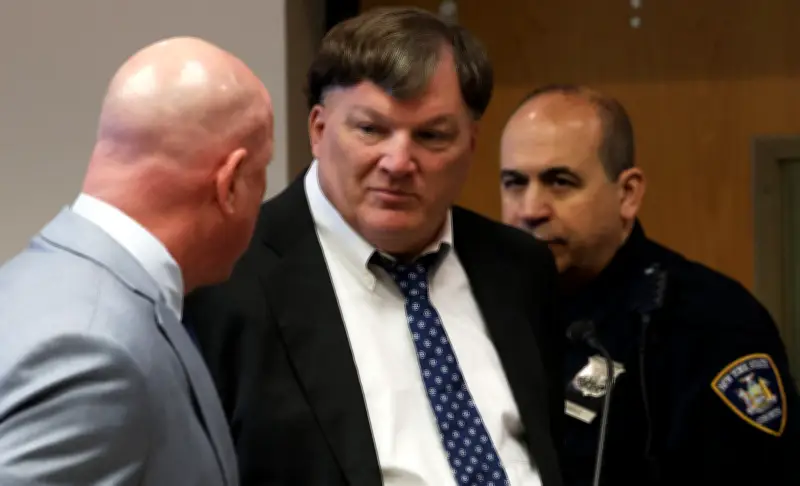
Rex A. Heuermann, the man accused of being the Gilgo Beach serial killer, has pleaded guilty in court to the murders of eight women. The plea comes after years of investigation into the remains discovered along a remote stretch of Long Island’s South Shore. However, the case is far from closed, as authorities continue to probe the deaths of several other individuals whose bodies were found in the same area.
Heuermann's Guilty Plea
Heuermann, a 61-year-old architect from Massapequa Park, New York, entered the plea in a Suffolk County courtroom. He admitted to the murders of eight women, all of whom were sex workers whose remains were discovered between 2010 and 2023. The victims include Melissa Barthelemy, Megan Waterman, Amber Costello, and Maureen Brainard-Barnes, known as the “Gilgo Four,” as well as four additional women: Valerie Mack, Jessica Taylor, Sandra Costilla, and an unidentified woman referred to as “Jane Doe No. 7.”
Prosecutors say Heuermann used burner phones and online platforms to contact his victims, often luring them with promises of payment for sexual services. He then allegedly killed them and dumped their bodies along Ocean Parkway near Gilgo Beach. The plea spares the victims’ families the ordeal of a trial, but many are left seeking closure for other unsolved cases.

Other Bodies Found on Gilgo Beach
The Gilgo Beach investigation, which began in 2010 with the discovery of the Gilgo Four, has since unearthed the remains of at least 10 other individuals. These include both men and women, some of whom may be connected to other killers or remain unidentified. Among them is a toddler, known as “Baby Doe,” whose body was found in a plastic bag in 2011. Authorities have not linked Heuermann to these deaths.
“The guilty plea is a significant step, but it does not answer every question,” said Suffolk County Police Commissioner Rodney Harrison. “We continue to work with the FBI and other agencies to identify all victims and bring any other perpetrators to justice.”
Victim Impact and Community Response
The families of Heuermann’s victims expressed relief at the plea but also grief over the years of uncertainty. “We finally have some measure of justice, but nothing can bring our daughter back,” said the father of one victim, who spoke on condition of anonymity. The case has also highlighted the vulnerability of sex workers and the need for better protections.
Community leaders have called for increased police patrols along the beach and better resources for missing persons cases. “This tragedy has shaken our community to its core,” said Suffolk County Executive Ed Romaine. “We are committed to ensuring that every victim is remembered and that justice is served fully.”
Ongoing Investigation
Law enforcement officials emphasize that the investigation is not over. They are reviewing evidence from Heuermann’s home and electronic devices for any links to other cases. Additionally, the FBI is using advanced DNA testing to identify the remaining unknown remains. “We owe it to these victims and their families to leave no stone unturned,” said FBI Special Agent in Charge Michael Driscoll.
The case has also prompted changes in how police handle missing persons reports, especially those involving marginalized groups. Advocacy groups are pushing for a national database to track missing sex workers, who are often overlooked in traditional investigations.
As Heuermann awaits sentencing, expected to be life in prison without parole, the families of the other Gilgo Beach victims hope that their loved ones will not be forgotten. The search for answers continues, both in the courtroom and on the sands of Long Island.