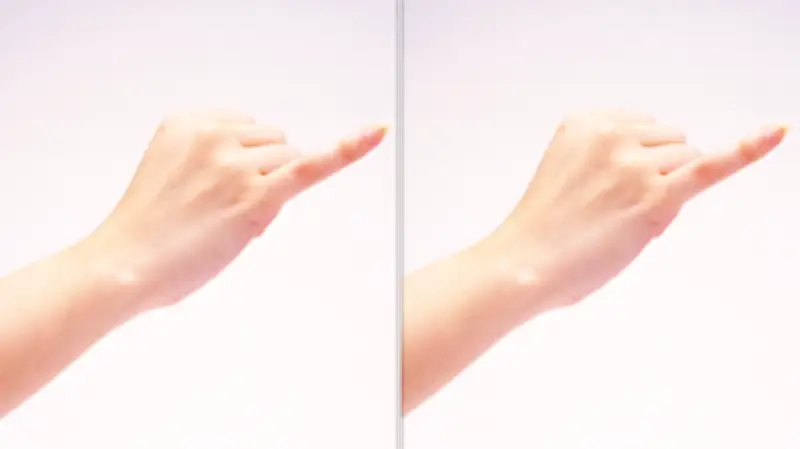
Could staving off memory loss be as simple as strategically wiggling your pinky fingers around every day? That is what TikTokers are claiming. Dubbed “pinky time,” the viral exercise is fairly simple: You hold your hands in front of you with your palms facing each other. Then, you interlace your index and middle fingers, touch your ring fingers to your thumbs together, and move your pinkies up and down for several seconds.
“Just seven to 10 seconds a day of this exercise can help protect against Alzheimer’s and improve brain plasticity,” one wellness influencer, Ana Lučić, says in one of the earliest videos on “pinky time.” If your pinky can move this easily, Lučić says, it is “a sign your brain is in great shape, because loss of fine motor control often mirrors cognitive decline.”
Those who post about pinky time say they do it at the same time each day. One TikToker claimed she and her friends observe “pinky time” at 7:45 pm on the dot every night.

What Neurologists Say About Pinky Time
Is there any truth to the TikTokers’ claims? Neurologists we spoke to say that research does suggest structured finger exercises can stimulate the brain, support neuroplasticity, and help ease symptoms of mild cognitive impairment in older adults. That is because finger exercises boost cognitive health by engaging the massive area of the brain’s motor cortex dedicated to the hands and fingers.
“The hands occupy a disproportionately large amount of the brain’s motor and sensory cortex,” explained Dr. Shaheen Lakhan, a neurologist and pain medicine specialist in Miami. “Activities that require dexterity, coordination, timing and learning can engage multiple brain networks simultaneously.”
But the specific movements used in the “pinky time” trend have not been studied, so it is important not to confuse a viral exercise with a proven medical intervention, Lakhan told HuffPost. “And we should distinguish between brain activation and dementia prevention,” he said. “Just because an activity activates the brain does not mean it prevents Alzheimer’s disease.”
The Real Value Is Challenge, Not the Pinky
The value of an exercise like pinky time is not focusing on the pinky; it is the challenge involved. “Learning a novel coordinated movement recruits brain networks involved in attention, motor planning, sensory processing, timing and learning,” Lakhan said. “The question isn’t whether the pinky moves; it’s whether the brain is being challenged in a meaningful way.” One of the most important concepts in neuroscience is that the brain adapts to challenge, he explained. “Neuroplasticity thrives at the intersection of novelty, complexity and repetition.”
Dr. Shae Datta, a clinical assistant professor in the department of neurology at NYU Grossman Long Island School of Medicine, added: “Performing fine motor tasks or rhythmic finger movements stimulates these neural pathways. Things like guitar, playing piano, tai chi and other martial arts, working with your hands, and art should all help strengthen these brain pathways.”
Drawbacks and Better Alternatives
There are other drawbacks with pinky time, besides the lack of research on the specific movements. Pinky time provides repetition, but it lacks enough complexity to suggest it would substantially alter long-term cognitive trajectories, Lakhan said. “As I often tell patients, cognitive decline isn’t prevented by a single movement. It’s resisted by a lifestyle that continuously asks the brain to adapt.”
That is why it is a great idea to take up a hobby that calls upon a lot of finger movement, said Dr. Shae Datta. “Performing fine motor tasks or rhythmic finger movements stimulates these neural pathways. Things like guitar, playing piano, tai chi and other martial arts, working with your hands and art should all help strengthen these brain pathways.” Other well-studied activities that have been shown to reduce the risk of dementia include reading, playing board games, crafting and dancing.

As for the TikTokers’ claim that you need to do finger exercises at a designated time every day, that is bunk. Move those digits whenever you want to get the benefits, Datta said.