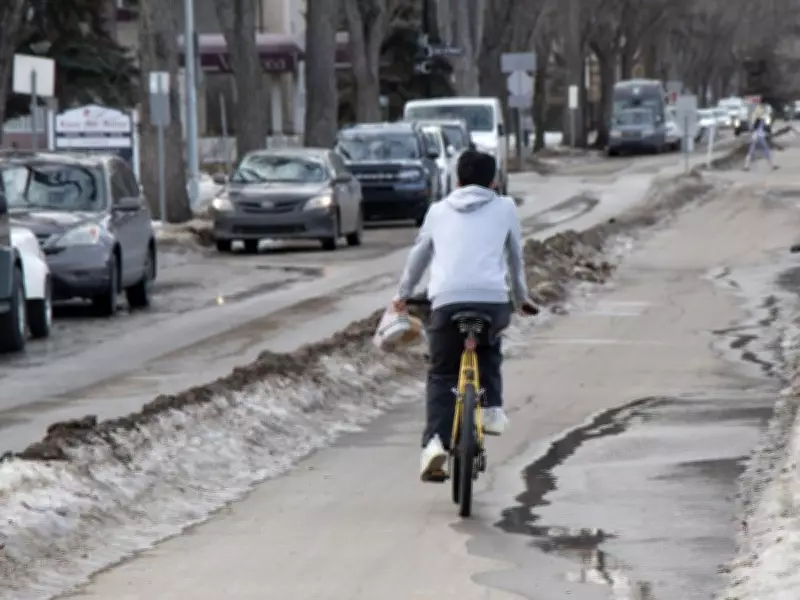
Edmonton Emerges as National Leader in Cycling Infrastructure Development
According to a comprehensive new study published in the Canadian Journal of Public Health, Edmonton has established itself as Canada's foremost city for expanding bicycle infrastructure during a period when numerous other municipalities and provinces are either slowing down or reversing their commitments to cycling networks.
Quantifying Edmonton's Remarkable Expansion
Over a concentrated two-year observation window, Edmonton added an impressive 517 weighted kilometres of cycling infrastructure. This substantial expansion more than doubles Calgary's addition of 245 kilometres and triples Toronto's growth of 140 kilometres during the same timeframe. The study employed sophisticated weighting methodologies that prioritize protected, dedicated cycling routes over simple painted lanes alongside roadways.
"Edmonton was certainly one of the fastest developing cities in terms of cycling infrastructure," emphasized Meghan Winters, a health sciences professor at Simon Fraser University and the study's lead author. "We see big increases in Edmonton, which I think is indicative that it is fast-moving, it is making major investments in cycling infrastructure."

Methodological Innovation for National Comparisons
Professor Winters addressed the significant challenge of comparing cycling infrastructure across Canadian cities, which traditionally employ different tracking and reporting methods. The research team turned to OpenStreetMaps as a consistent data source, creating what Winters describes as an "apples-to-apples" comparison framework that accounts for variations in volunteer mapping efforts across regions.
"We also see a really connected network along the river," Winters noted regarding Edmonton's development pattern. "We also see a lot of infrastructure making connections in the downtown core and in neighbourhoods. And it appears that over 2022 to 2024 a lot of infrastructure was put down on the ground."
National Context and Infrastructure Quality Assessment
While Edmonton's progress stands out, the study documented nationwide growth of 3,596 kilometres in cycling infrastructure overall. Multi-use pathways accounted for 2,725 kilometres of this expansion, representing a substantial 75.8 percent increase in distance over the two-year period. These multi-use paths, typically situated adjacent to or separate from roadways, are classified as providing "medium comfort" for cyclists.
The research methodology gave additional recognition to municipalities investing in high-quality, all-ages-and-abilities bicycle infrastructure through its weighted measurement system. This approach acknowledges that not all cycling infrastructure provides equal safety and accessibility benefits.
Persistent Equity Challenges in Infrastructure Distribution
One concerning finding that emerged consistently across Canadian urban centers relates to infrastructure distribution disparities. Areas with higher concentrations of children and older adults tend to have less cycling infrastructure available, creating accessibility gaps for vulnerable populations.
"Total distance is one metric, but it's not necessarily the only consideration — it's important to look at the type of infrastructure and who benefits from access," Winters cautioned. "Our research has shown that things are improving, but not everyone is feeling those improvements."
The study underscores Edmonton's exceptional commitment to cycling infrastructure during a period of mixed national progress, while simultaneously highlighting ongoing challenges in ensuring equitable access to safe cycling networks across all Canadian communities.