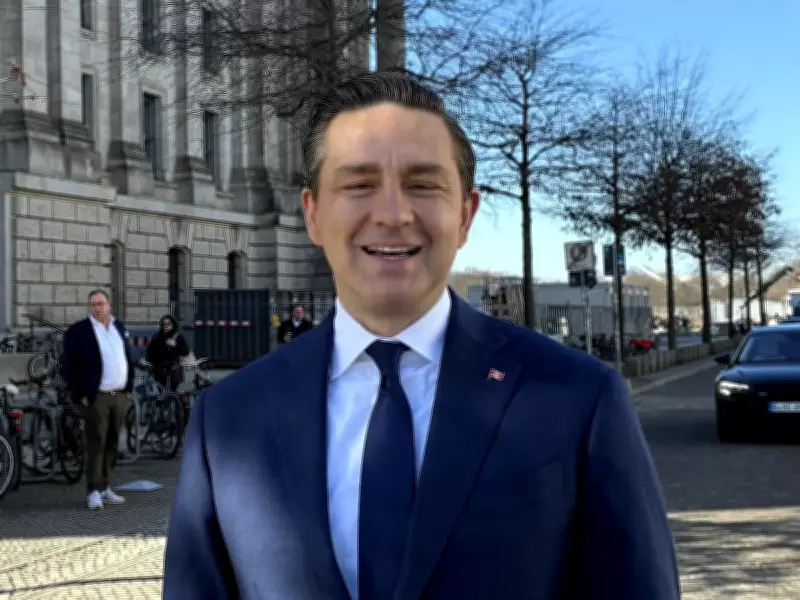
Conservative Leader Pierre Poilievre is set to present his ambitious plan for expanding Canadian natural gas exports to Germany during a crucial meeting with the country's Foreign Minister Johann Wadephul in Berlin on Thursday. This high-level diplomatic engagement marks a significant moment in Poilievre's efforts to position himself as a statesman capable of advancing Canadian economic interests on the global stage.
Diplomatic Mission in Berlin
During his first and only full day in the German capital, Poilievre's schedule includes attending a session of the Bundestag, Germany's federal parliament, and meeting with various members of parliament and prominent business leaders. The Conservative leader's team has maintained their practice of not releasing a complete list of meeting participants beforehand, maintaining an element of strategic discretion throughout this week-long international trip.
Speaking briefly to reporters on Thursday morning, Poilievre emphasized that his primary focus during these diplomatic encounters would be advocating for his comprehensive plan to develop Canada's natural gas sector and establish export channels to Germany. "The Germans want our gas. They've asked for it," Poilievre stated confidently. "They have built import terminals that can receive it, and I'm here to talk about my idea of a natural gas supply agreement that would require us to rapidly approve LNG export terminals and pipelines."

Economic and Strategic Arguments
Poilievre presented compelling economic arguments for his proposal, suggesting that such an arrangement would prove "massively profitable" for Canada while simultaneously reducing natural gas costs significantly for German consumers and industries. This pitch comes at a time when Germany has been actively seeking to diversify its energy sources and strengthen energy security partnerships.
Before entering the historic Bundestag building for his parliamentary engagement, Poilievre made a symbolic stop at a nearby memorial commemorating Germans who lost their lives while attempting to flee East Germany before the fall of the Berlin Wall. This gesture underscored the broader context of international cooperation and shared values between the two nations.
First Foreign Mission as Conservative Leader
This European tour represents Poilievre's inaugural foreign mission since assuming leadership of the Conservative Party in 2022, with previous stops in London and upcoming engagements in Hamburg. The Conservative Party of Canada is financing the entire trip, during which Poilievre is accompanied by a small team of senior aides, photographers, and his wife Anaida Poilievre, who coincidentally celebrates her 39th birthday on Thursday.
The timing of this diplomatic initiative is particularly significant as Poilievre works to cultivate his image as a credible international figure capable of promoting Canadian industry and strategic interests to key foreign allies. This effort represents a deliberate expansion of his political profile beyond domestic concerns.
Policy Commitments and International Perspectives
During a speech delivered on Wednesday evening, Poilievre made substantial policy commitments, promising that a future Conservative government would establish binding supply agreements with allied nations like Germany to provide them with Canadian natural gas. He further pledged to "override bureaucracies and other levels of government" to accelerate the construction of essential pipelines and LNG terminals necessary for such exports.
In a subsequent panel discussion featuring Poilievre, German government MP Jürgen Hardt offered insightful perspective on the historical context of Canada-Germany relations. Hardt, who served as the German government's co-coordinator of transatlantic cooperation from 2014 to 2018, suggested that both countries had fallen into what he termed a "friendship trap" that had inadvertently slowed bilateral trade development until recent years.
"Because there were no problems with Canada on the table, the contact between government and also members of parliament was very few, and also probably the contact between business people was too few," Hardt explained, highlighting how historically smooth relations might have paradoxically limited deeper economic engagement.

This diplomatic mission represents a strategic effort to transform that historical dynamic into more substantive economic cooperation, with natural gas exports serving as a potential cornerstone for strengthened Canada-Germany relations in the coming years.