Copper Quest Completes AI-Driven Analysis at Kitimat, Identifies Large Concealed Conductive Target
VANCOUVER, British Columbia – Copper Quest Exploration Inc. (CSE: CQX; OTCQB: IMIMF; FRA: 3MX) has announced the successful completion of its artificial intelligence-driven geological analysis at its fully-owned Kitimat Copper-Gold Project in northwestern British Columbia. The advanced analysis has confirmed the presence of a large conductive anomaly that aligns with geological models of a buried porphyry center, marking a significant development in the company's exploration efforts.
AI Technology Uncovers Promising Geological Formation
The AI analysis has identified a substantial buried conductive body measuring approximately 1.5 kilometers by 1.5 kilometers in lateral extent. This anomaly demonstrates strong vertical continuity reaching depths of at least one kilometer—the maximum limit of the current analysis—and begins just 50 meters below the surface, concealed beneath sedimentary cover. The conductor is positioned within a pronounced magnetic gradient corridor, with spatial relationships suggesting an intrusive contact or alteration boundary, and lies in proximity to documented volcanic-hosted sulphide mineralization.
Brian Thurston, CEO of Copper Quest, emphasized the importance of this discovery: "The completion of our AI-driven analysis represents a significant advancement at Kitimat. The AI generation of this extensive conductive anomaly, positioned along a structural magnetic boundary within fertile arc volcanics, could very well indicate a concealed intrusive porphyry center. Historical mineralization drilled nearby yielded substantial near-surface copper-gold intercepts that remain open, supporting our geological interpretation that these intercepts may represent the outer expression of a much larger porphyry system, potentially corresponding to the AI-generated anomaly now observed."

Strategic Partnership Drives Technological Innovation
Copper Quest announced its strategic partnership with U.S.-based Exploration Technologies Inc. (ExploreTech) on December 1, 2025, to deploy generative artificial intelligence across its project portfolio, beginning with the Kitimat Copper-Gold Project. Using the ExploreTech platform, historical information from the Kitimat project was integrated and reprocessed, including:
- Historical diamond drilling data from the 2010 Jeannette Cu-Au Zone
- Government airborne magnetics and VTEM conductivity data
- Structural and lithological interpretations
- 2025 field observations and alteration mapping
- Soil and rock geochemistry samples
The platform synthesized this historical information into a unified probabilistic 3D geological framework while the AI system generated thousands of subsurface geological scenarios, ranking probability clusters for concealed intrusive centers and sulphide-rich alteration zones.
Expert Validation of AI Methodology
Alex Miltenberger, PhD, CEO of ExploreTech, commented on the technological approach: "Our generative AI platform evaluates thousands of geological and geophysical permutations to identify the highest-probability mineralized centers. At Kitimat, the integrated magnetic, VTEM, drilling, and geological datasets produce a coherent target architecture consistent with buried intrusive-related mineralization. This platform has been successfully applied to multiple porphyry systems worldwide, and we look forward to supporting Copper Quest as they advance this project toward drill confirmation."
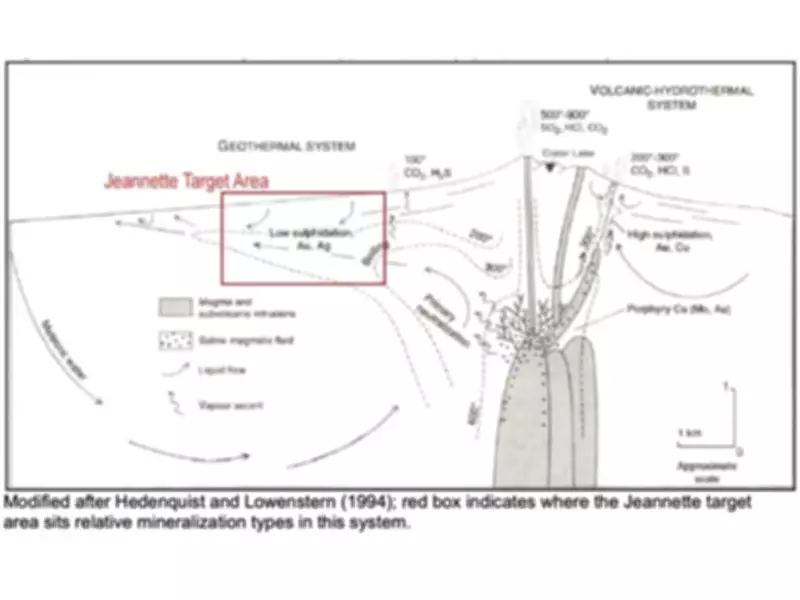
The presumed geological setting of the Jeannette zone within the larger Kitimat claim block was originally documented in a National Instrument 43-101 report written on the Kitimat property by Jeremy Hanson, P.Geo, in 2020. This historical context provides important background for understanding the significance of the newly identified conductive target.

The discovery represents a major step forward in mineral exploration technology, demonstrating how artificial intelligence can process complex geological datasets to identify promising targets that might otherwise remain concealed. Copper Quest's application of AI-driven analysis at Kitimat showcases the growing role of advanced technology in modern resource exploration, potentially setting a new standard for efficiency and accuracy in the industry.