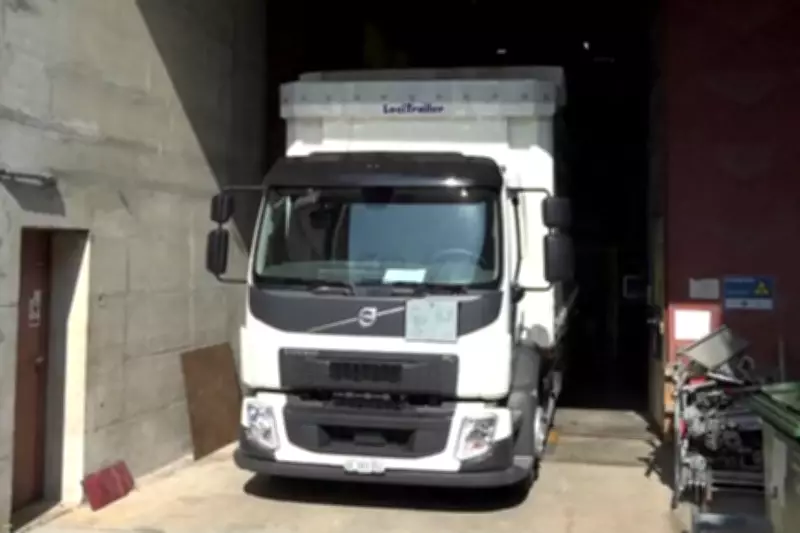
CERN Achieves Historic Milestone with Antimatter Transportation Test
In a landmark scientific achievement, researchers at the European Organization for Nuclear Research (CERN) in Geneva have successfully conducted the first-ever test drive transporting antimatter. This delicate experiment, carried out on March 24, 2026, marks a significant advancement in the study of one of the universe's most mysterious substances.
A Delicate Operation with Profound Implications
The test involved carefully moving antiprotons in a specialized truck from CERN's facilities in Meyrin, near Geneva, Switzerland. Antimatter, which consists of particles with properties opposite to normal matter, is notoriously difficult to handle due to its tendency to annihilate upon contact with ordinary matter. This successful transportation demonstrates remarkable progress in containment and manipulation techniques.
This breakthrough opens new avenues for antimatter research, potentially leading to deeper understanding of fundamental physics principles and the early universe. Scientists have long sought to study antimatter's properties more extensively, but its instability has posed significant challenges to transportation and experimentation beyond controlled laboratory environments.

Overcoming Technical Challenges
The transportation required sophisticated equipment and precise coordination to maintain the antimatter's stability during movement. Researchers developed specialized containment systems that could withstand the vibrations and environmental changes encountered during road transport while preventing annihilation events.
The successful test represents years of preparation and technological innovation at CERN, where scientists have been pushing the boundaries of particle physics research for decades. This achievement builds upon previous antimatter research at the facility, including the creation and trapping of antihydrogen atoms.
Future Research Directions
With this transportation capability established, scientists anticipate several important developments:
- Enhanced collaboration between research facilities that can now share antimatter samples
- More diverse experimental setups that were previously impossible due to location constraints
- Potential applications in medical imaging and cancer treatment through improved understanding of particle interactions
- Advanced testing of fundamental symmetry principles in physics
The CERN team emphasized that this successful test represents just the beginning of expanded antimatter research possibilities. As transportation methods become more refined and reliable, scientists expect to accelerate discoveries about the nature of antimatter and its role in the cosmos.
This achievement underscores CERN's continued leadership in particle physics research and demonstrates how persistent scientific inquiry can overcome even the most daunting technical challenges. The successful antimatter transport test promises to open new chapters in our understanding of the fundamental building blocks of the universe.