A groundbreaking discovery in the field of astronomy has been made by a Canadian-led team of researchers, who have uncovered a so-called 'ghost galaxy' that is composed almost entirely of dark matter. This mysterious celestial object, which challenges our understanding of galactic formation, was identified through advanced imaging techniques and analysis of data from space telescopes.
The Elusive Nature of Dark Matter Galaxies
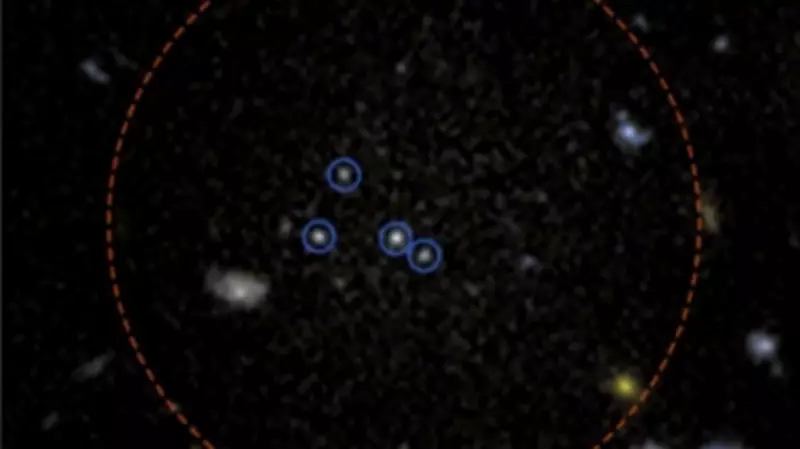
Dark matter, which does not emit, absorb, or reflect light, makes up approximately 85% of the universe's mass, yet it remains one of the most enigmatic components of cosmic structure. The newly discovered galaxy, often referred to as a 'ghost galaxy' due to its faint and elusive appearance, provides a rare opportunity to study dark matter in a relatively isolated environment. According to the research team, led by scientists from the University of Toronto, this galaxy exhibits only four globular clusters of stars that are visible around its suspected dark matter core.
Imaging and Data Analysis
The discovery was made possible through the use of data from NASA's Hubble Space Telescope and the European Space Agency's observatories, processed by experts including J. DePasquale at the Space Telescope Science Institute. The imaging reveals a sparse distribution of stars, suggesting that the galaxy's mass is predominantly dark matter, with minimal luminous material. This finding aligns with theoretical models that predict the existence of such dark matter-dominated galaxies, but observational evidence has been scarce until now.

Implications for Astrophysics
This discovery has significant implications for our understanding of galaxy formation and the role of dark matter in the universe. It supports the hypothesis that dark matter can form structures independently of visible matter, potentially leading to the creation of 'dark galaxies' that are invisible to traditional telescopes. The Canadian-led team's work contributes to ongoing efforts to map the distribution of dark matter and refine cosmological models.
Further research is planned to investigate the properties of this ghost galaxy, including its mass, size, and interaction with neighboring celestial bodies. Scientists hope that such studies will shed light on the fundamental nature of dark matter and its influence on the evolution of the cosmos.