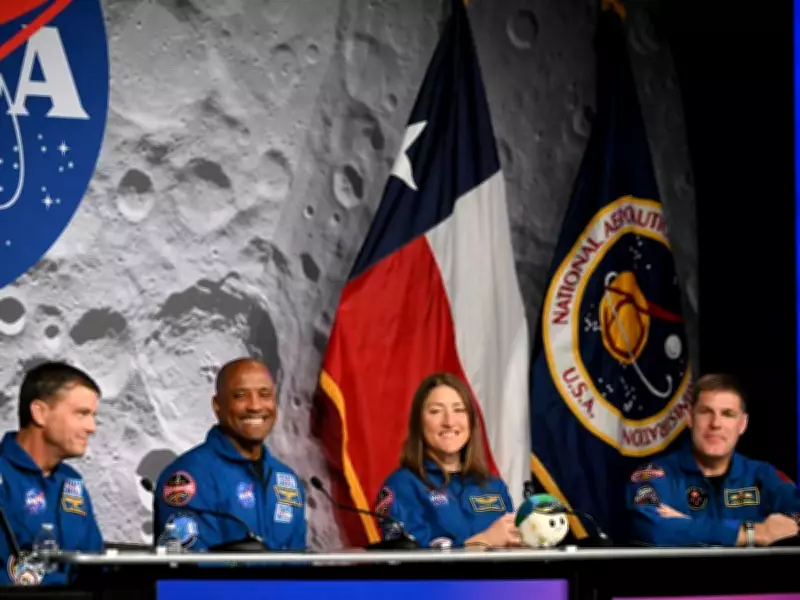
Artemis II Astronauts Reflect on Historic Lunar Mission and Unbreakable Bond
Six days after their triumphant return to Earth, the four astronauts of the historic Artemis II mission shared profound insights into their journey during a press conference at NASA's Johnson Space Center in Houston, Texas. Commander Reid Wiseman, pilot Victor Glover, mission specialist Christina Koch, and Canadian Space Agency astronaut Jeremy Hansen expressed a deep sense of camaraderie and optimism for the future of space exploration.
A Friendship Forged in Space
Commander Reid Wiseman, a 50-year-old naval aviator-turned-astronaut, eloquently captured the essence of their shared experience. "We launched as friends and came back as best friends," he remarked, reflecting on the intense ten-day mission spent in the confined quarters of the Orion spacecraft. Wiseman emphasized the unique bond formed among the crew, stating, "We are bonded forever. No one down here is ever going to know what the four of us just went through, and it was the most special thing that will ever happen in my life."
The commander began the conference by extending gratitude on behalf of the entire crew. "We're just going to start by thanking the world," Wiseman said. "We were certainly hooked on this mission, but when we came home, we were shocked at the global outpouring of support, of pride, of ownership of this mission."

Breaking Barriers and Setting Records
The Artemis II mission marked a monumental achievement in human spaceflight, being the first lunar mission in over five decades. The crew traveled an unprecedented distance of 400,171 kilometers from Earth, setting a new record for the furthest journey in human spaceflight history.
This mission also shattered significant barriers:
- Victor Glover became the first Black astronaut to pilot a lunar mission.
- Christina Koch made history as the first woman to travel to the far side of the moon.
- Jeremy Hansen of London, Ontario, achieved the distinction of being the first non-American to fly around the moon.
Teamwork and Public Inspiration
Pilot Victor Glover highlighted the collaborative nature of their mission, noting that every activity was a team effort. "Everything we did was a four-person activity — a minimum of everything; how we ate, slept, flew the vehicle. And some of it was on purpose, but a lot of it was realized in real-time," Glover explained. "It was a team effort to the last period."
Canadian astronaut Jeremy Hansen shared his heartfelt reaction to learning how the public had followed their mission with keen interest. "Humans are just great people, in general. We don't always do great things … but our default is to be good and to be good to one another," Hansen said. "And what I've seen has brought me more joy … more hope for our future. And I just can't wait to see what we do with it next."
Mission specialist Christina Koch echoed this sentiment, emphasizing the importance of their mission's impact on people worldwide. "It was every bit as important as accomplishing the mission's technical goals," she stated.
Challenges and Technical Details
Since their return, the astronauts have been undergoing mandatory medical evaluations and technical debriefings. Commander Wiseman revealed that aside from the widely reported space toilet issue—which he described as "wonderful" and functional despite a clogged vent line—the crew faced a tense moment with a smoke detector alarm on the second-last day of the mission.
"You want to get somebody's attention really quick? Make the fire alarm go off in your spacecraft when you're still about 80,000 miles from home," Wiseman recounted. "It wasn't scary, but it was tense for a few minutes until we got things reconfigured."
Despite these challenges, Wiseman expressed strong confidence in the spacecraft's reliability for future missions. "They could put the Artemis III Orion on the space launch system tomorrow and launch it and the crew would be in great shape," he asserted.

Looking Ahead: The Future of Artemis
The Artemis II mission served as a critical test of the Orion spacecraft's systems, including life-support, communication, and navigation capabilities. NASA is already advancing its lunar exploration agenda with ambitious plans for subsequent missions:
- Artemis III, targeted for launch in 2027, will test rendezvous and docking procedures between Orion and a commercial spacecraft designed to land astronauts on the moon. A crew of four astronauts is anticipated for this mission.
- Artemis IV, scheduled for 2028, aims to land two astronauts on the moon's south pole, marking a significant step toward sustained lunar exploration.
The Artemis II astronauts' reflections not only celebrate a historic achievement but also inspire hope for the continued expansion of human presence in space, driven by innovation, international collaboration, and an unbreakable spirit of exploration.