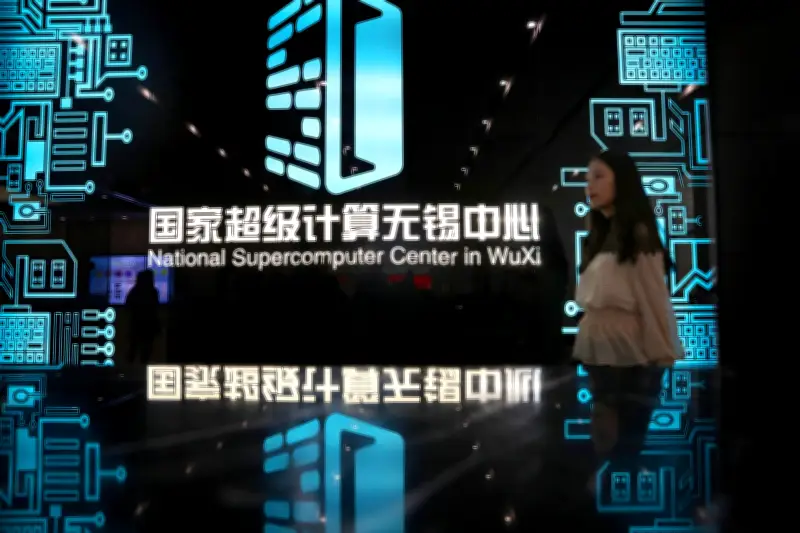
China has overtaken the United States with the world's fastest supercomputer, according to a report by Reuters. The achievement marks a significant milestone in the ongoing technological rivalry between the two nations, but experts note that the current race is not geared toward artificial intelligence workloads.
New Speed Leader
The Chinese supercomputer, housed at the National Supercomputer Center in Wuxi, Jiangsu province, has reclaimed the top spot on the global ranking of high-performance computing systems. The system, known as the Shenwei (Sunway) TaihuLight, was previously the fastest in 2016 but had been surpassed by US machines in recent years.
Reuters reported that the latest version of the TaihuLight achieved a peak performance of over 200 petaflops, significantly outpacing the current US leader, the Frontier system at Oak Ridge National Laboratory, which operates at around 150 petaflops.

Focus on Traditional Computing
Despite the speed advantage, the Chinese supercomputer is not optimized for AI tasks, which require specialized hardware such as graphics processing units (GPUs) or tensor processing units (TPUs). The TaihuLight relies on its own Shenwei processors, which are designed for general-purpose computing rather than the matrix operations central to AI.
“China’s supercomputer is impressive for traditional scientific simulations, but the US still leads in AI-optimized systems,” said a high-performance computing analyst quoted by Reuters. The US Department of Energy has invested heavily in AI-capable supercomputers, including the upcoming El Capitan system, expected to exceed 2 exaflops for AI tasks.
Implications for the Tech Race
The development underscores the divergent paths in the US-China technology competition. While China emphasizes raw computing power for weather modeling, drug discovery, and defense applications, the US prioritizes AI integration for machine learning and data analytics.
“This is not just about speed; it’s about what you can do with that speed,” the analyst added. “For AI, the US still has a clear edge.”
Historical Context
The TaihuLight supercomputer first claimed the top spot in June 2016 with a peak performance of 93 petaflops. It was later overtaken by Japan’s Fugaku in 2020 and the US Frontier in 2022. The latest upgrade brings it back to number one, but the landscape of high-performance computing is shifting toward AI-specific architectures.
Reuters noted that the US government has restricted exports of advanced AI chips to China, affecting the development of AI supercomputers there. In response, China has accelerated domestic chip production, though challenges remain.
“The race is far from over,” the report concluded. “Both nations are investing billions, but the metrics of success are changing.”