

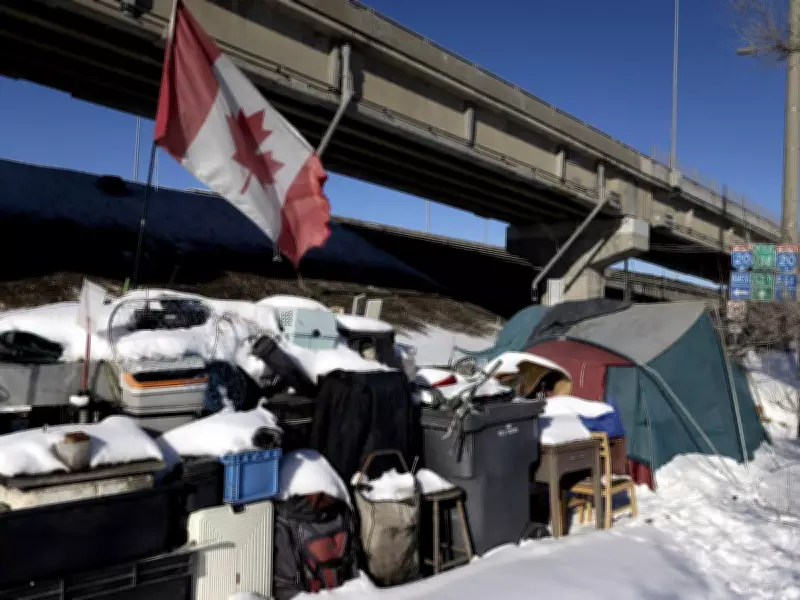
Dozens of Montreal organizations dedicated to aiding people experiencing homelessness are facing the grim prospect of service reductions as provincial government funding remains stagnant, failing to keep pace with escalating operational costs. Advocates argue that the Quebec 2026 budget, while replacing some federal dollars, neglects inflationary pressures, jeopardizing critical support systems.
Budget Details and Advocacy Concerns
Quebec's 2026 budget, unveiled on Wednesday, allocates nearly $90 million over five years to address homelessness and prevention efforts, with the majority of funds concentrated in the initial three years. However, Annie Savage of Réseau d’aide aux personnes seules et itinérantes de Montréal highlights that only $24.8 million constitutes new provincial spending. This amount is intended to offset federal funding set to expire on April 1, following the non-renewal of a federal program in Ottawa's latest budget.
"That was the bare minimum that could be expected but, of course, that's far below the actual needs on the ground," Savage remarked, emphasizing the inadequacy of the allocation. The remainder of the budgeted funds represents a renewal of previous years' grants, which have not been indexed to inflation for the past five years. Consequently, organizations are grappling with diminished purchasing power despite stable nominal funding levels.

Impact on Frontline Services
Paméla Simard, who oversees the housing program at Rue Action Prévention Jeunesse, a community group active in Montreal's Bordeaux-Cartierville, St-Laurent, and Ahuntsic neighborhoods, illustrates the practical ramifications. Her request for funding to provide psychosocial support for residents in modular homes was denied, while other provincial funding has remained unchanged for five years, despite soaring operating expenses.
Simard explained that the modular homes project, a collaboration with the City of Montreal, typically receives such grants. Without additional resources, RAP Jeunesse can only accommodate about 20 people, despite the physical capacity to house between 27 and 30 individuals. This shortfall affects vulnerable populations, including those in encampments who avoid traditional shelters due to pets or partners.
"It's not enough to only offer people shelter," Simard noted, stressing the necessity of intervention workers to guide residents toward stable housing and provide essentials like food. Inflation has eroded her organization's ability to purchase groceries or cover transportation costs for clients visiting apartments or applying for social assistance.
Broader Organizational Struggles
Luis-Carlos Cuasquer, executive director of Le PAS de la rue, which serves homeless individuals aged 55 and older, warns that his group may be forced to curtail services. Last year, they opened an overflow facility to handle an average of 120 daily visitors at a day centre designed for 60, but this expansion could close by late April without extra funding.
Cuasquer advocates for a shift toward long-term solutions, urging the government to provide recurring, inflation-indexed funding. "If we really want to address homelessness, we need to stop funding emergency measures and start funding long-term solutions by supporting the overall mission of organizations so that they can be effective," he asserted.
Government Response and Future Outlook
Finance Minister Eric Girard described homelessness as an "urgent priority" in the budget, citing "targeted measures" to tackle the issue. However, a spokesperson for the minister did not respond to requests for comment on the concerns raised by advocacy groups. As organizations brace for potential cuts, the debate underscores the growing tension between fiscal constraints and the escalating humanitarian crisis on Montreal's streets.






