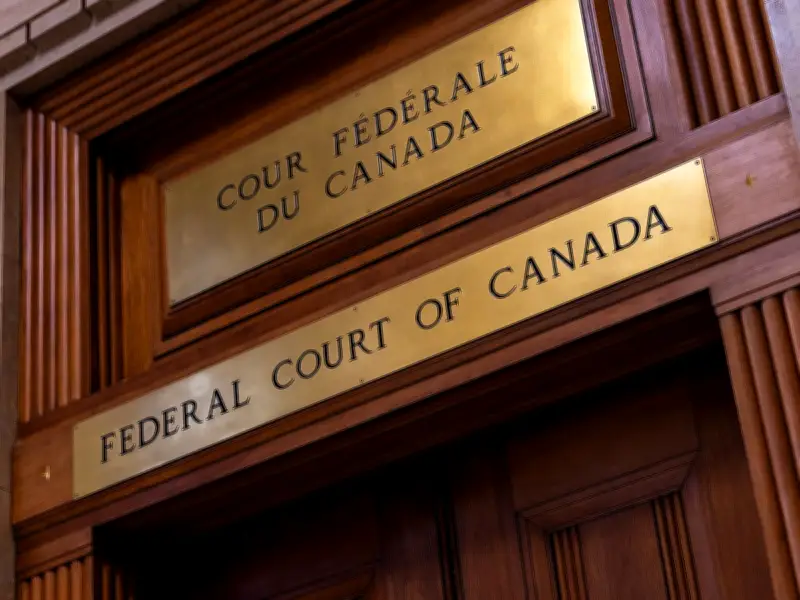
A Federal Court judge has overturned a Canadian immigration officer's decision to deny permanent residency to Kiley Gem Williams, a 37-year-old member of the Choctaw Nation of Oklahoma, ruling that the officer failed to properly consider systemic factors affecting Indigenous people and the best interests of her children.
Background of the case
Williams was denied permanent residency due to convictions for impaired driving and drug possession in the United States. The immigration officer found her “criminally inadmissible” and refused her spousal sponsorship application. Williams sought judicial review of the officer's decision to deny an exception on humanitarian and compassionate grounds.
Justice Shirzad Ahmed of the Federal Court in Ottawa issued the decision on June 16, 2026. He wrote that the officer “was obliged to — and failed to — reasonably grapple with the systemic factors” that Williams faces as an Indigenous person.

Systemic factors overlooked
Ahmed noted that the officer acknowledged Williams' past struggles with substance use and lack of strong family support, as well as evidence linking mental health challenges in Indigenous communities to intergenerational trauma from colonization. However, the officer did not consider the specific implications of these systemic challenges in Williams' context, including her experience in foster care throughout childhood and her parents' substance abuse issues and eventual death.
“The officer does not grapple with the specific implications of these systemic challenges in the particular context of the applicant,” Ahmed wrote.
Family and relationship history
Williams met her Canadian spouse in 2016, and they married in 2018. They separated in 2019 due to the long-distance nature of their relationship but reconciled in 2020. Williams and her son eventually lived with her spouse in Texas and Georgia. In 2021, her spouse became joint legal guardian of her son.
The couple renewed their vows in March 2022. Williams and her son moved to Canada in 2023 on temporary resident permits. She gave birth to a daughter in the U.S. in January 2024 but returned to Canada the following month.
Criminal convictions
Williams was charged in 2019 and 2020 with possession of a controlled substance and driving under the influence. She was convicted of both charges in 2022. For possession, she received 12 months of probation, later reduced to 30 days of unsupervised probation. For DUI, she received six months of probation.
She applied for permanent residency in spring 2024, requesting an exception on humanitarian and compassionate grounds. The immigration officer denied the application in March 2025, ruling that the severity of her convictions outweighed the humanitarian considerations.
Court's ruling
Ahmed found that the officer's internal notes acknowledged that Williams' family would be negatively affected by removal and that she and her children were established in Canada. However, the officer noted that Williams had established herself in both Canada and the U.S. and owned multiple properties with her spouse in both countries.
The judge concluded that the officer failed to properly consider the best interests of Williams' children and the systemic factors affecting her as an Indigenous person. The decision was set aside, and the matter will be reconsidered by a different immigration officer.