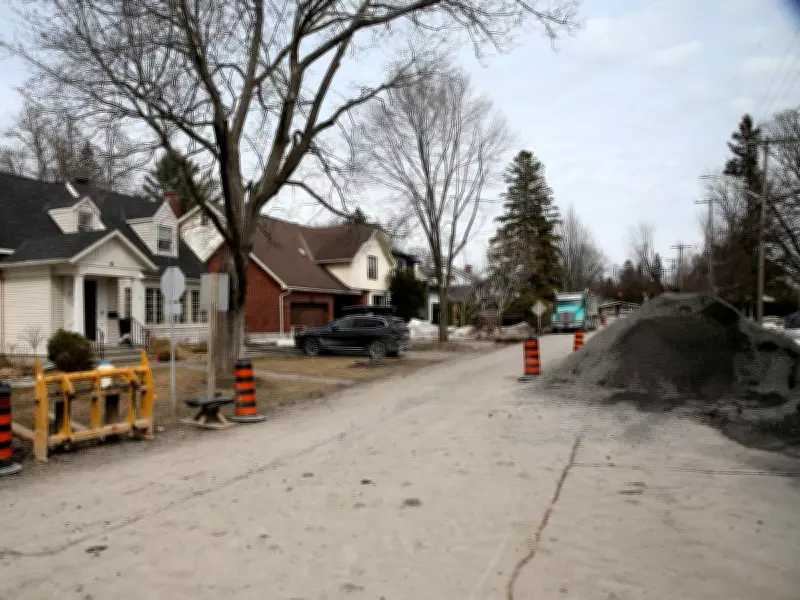
Manor Park Sidewalk Plan Ignites Council Debate Over Long-Term Infrastructure Legacy
A contentious proposal to install sidewalks on four quiet streets in Ottawa's Manor Park neighborhood has sparked a heated debate at city council, highlighting the challenges of making infrastructure decisions that will far outlast current residents. The discussion centered on whether to proceed with a $180,000 sidewalk installation as part of a broader $13.9-million neighborhood renewal project.
Divided Community and Conflicting Surveys
Residents of Manor Park, located west of St-Laurent Boulevard, have expressed sharply divided opinions about the sidewalk proposal. Some residents argue that sidewalks provide essential safety for pedestrians, including those with disabilities and mobility challenges. They emphasize the importance of accessible infrastructure for all community members.
Other residents contend that the streets are not particularly busy and that wide, flat streets actually serve mobility-challenged individuals better than narrow sidewalks would. This disagreement has created a complex situation for city officials trying to balance immediate community preferences with long-term planning considerations.

The division is reflected in conflicting survey results. A city-conducted survey found that slightly over half of neighborhood residents preferred no sidewalks. However, Rideau-Rockcliffe Councillor Rawlson King's own consultation revealed that 79 percent of respondents opposed the sidewalk installation.
Councillor King's Failed Motion and Cost Considerations
Councillor King presented a motion to city council on April 8 seeking to remove some sidewalks from the renewal project. He argued that "Manor Park will see more change within the next 10 to 15 years than in the last 50" and that this warranted proper study before work was undertaken.
"The motion was about applying city policies in a way that reflected how people moved through their neighborhoods," King explained. "It also reflects our role as councillors to ensure that citywide approaches are implemented in a way that makes better sense for the communities we represent."
Despite King's arguments, his motion failed by a decisive 16-7 vote. Financial considerations played a significant role in the debate, with city staff noting that installing sidewalks now for $180,000 would avoid paying between $500,000 and $700,000 to add those same sidewalks later as separate projects.
Generational Perspectives and Democratic Principles
The council debate revealed deeper philosophical differences about municipal decision-making. River Ward Councillor Riley Brockington argued that residents should be allowed to disagree with city plans in their own neighborhoods, stating that "this is a democracy and city councillors aren't employees of the City of Ottawa."
On the other side of the debate, several councillors emphasized that decisions made today would affect future generations for decades to come. Kitchissippi Ward Councillor Jeff Leiper provided a compelling example from his own ward, where Westboro was originally built to rural standards with ditches and still lacks sidewalks in many areas.
Leiper noted that in previous decades, councillors could influence these decisions through consultation with residents, and if communities didn't want sidewalks, they weren't built. However, he observed that newer residents often have different expectations about urban infrastructure.
"The new residents of Westboro have a very different understanding of how streets should function than many of the people who have lived there for decades," Leiper said. "And, if we don't take the opportunity to put sidewalks in when we do the street rebuilds, we are not going to have that opportunity again for 70 or 80 or 90 years."
Broader Implications for Urban Planning
The Manor Park sidewalk debate highlights the tension between respecting current community preferences and planning for future needs. As cities evolve and demographics shift, infrastructure decisions made today create lasting legacies that will shape neighborhoods for generations.

The four streets specifically under consideration are Arundel Avenue, Jeffrey Avenue, Kilbarry Crescent, and Braemar Street. The broader $13.9-million renewal project includes not just potential sidewalk improvements but also comprehensive road, water, and sewer main upgrades throughout the neighborhood.
This case illustrates how municipal governments must balance multiple factors: immediate resident preferences, long-term planning considerations, financial implications, accessibility requirements, and evolving community standards about what constitutes safe and functional urban spaces.