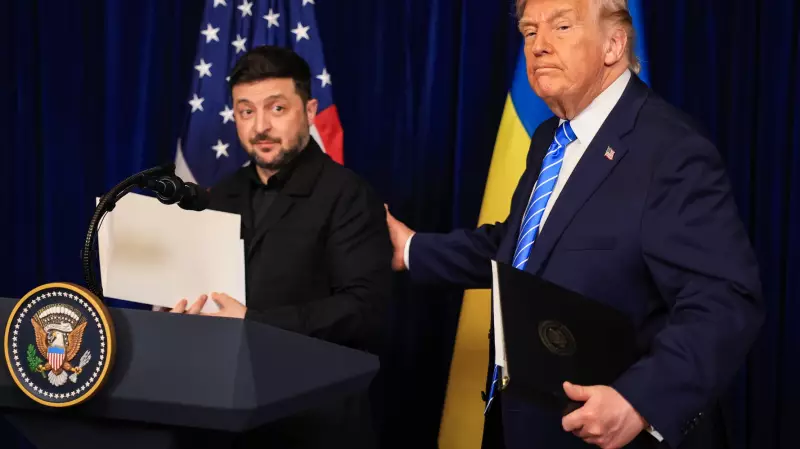
Hopes for a swift diplomatic resolution to the war in Ukraine have hit a significant roadblock, with Kyiv and Moscow remaining deeply divided on critical territorial issues. This stalemate persists despite reported progress on security guarantees for Ukraine following discussions between U.S. President Donald Trump and Ukrainian leader Volodymyr Zelenskyy.
Core Territorial Disputes Halt Progress
Following talks in Florida on Sunday, President Trump indicated that an agreement to end the conflict was closer, citing movement on security matters. However, he acknowledged that "thorny issues" remained unresolved. Ukrainian President Volodymyr Zelenskyy identified the two primary obstacles on Monday: the operational control of the Russian-occupied Zaporizhzhia Nuclear Power Station and the status of the eastern Donbas region.
The chasm between the two sides was starkly illustrated by Kremlin spokesman Dmitry Peskov. He stated that any deal requires Ukraine to withdraw its military from the portions of Donbas it still controls. Peskov warned that Kyiv would risk losing more territory if it refused an agreement, underscoring Moscow's uncompromising position.

Security Guarantees Advance as Trump-Putin Call Looms
A potential bright spot emerged from the U.S.-Ukraine talks. Zelenskyy announced a bilateral agreement on security guarantees for Kyiv, though Trump noted they were only "95% ready." The Ukrainian leader expressed a desire for a long-term pact, suggesting a duration of up to 50 years given the prolonged nature of the conflict, which began with Russia's annexation of Crimea in 2014.
President Trump indicated he expects European nations to shoulder a major part of this security commitment with American support. This coordination faces complications, as Russia has repeatedly stated that any foreign troop deployment in Ukraine would be unacceptable. A call between Trump and Russian President Vladimir Putin is planned for the near future.
Deep Mistrust and Military Reality
Despite diplomatic overtures, profound distrust defines the relationship. Russia launched a heavy assault on Ukraine just as the Florida talks began, intensifying attacks on energy infrastructure as winter sets in. This resulted in widespread power outages in Kyiv amidst freezing temperatures.
While Trump reiterated his belief that Putin wants to end the war, Zelenskyy publicly questioned the Russian leader's sincerity. "In my opinion, (Putin’s) actions do not coincide with the seemingly peaceful rhetoric," Zelenskyy stated. Putin has maintained that Russia will achieve its objectives by force if diplomacy fails, demanding Kyiv accept Moscow's terms.
On the ground, Russia controls approximately one-fifth of Ukraine's territory. Its demands for a Ukrainian withdrawal from unoccupied parts of Donetsk clash with Kyiv's position, which seeks a ceasefire along current front lines. A proposed free economic zone for the region, mentioned by Washington, lacks a detailed plan according to Zelenskyy, and Russia has rejected ceasefire-linked referendums.
The path to peace remains fraught, with core issues of sovereignty and security still separating the warring parties, leaving a swift end to Europe's deadliest conflict since World War II uncertain.