

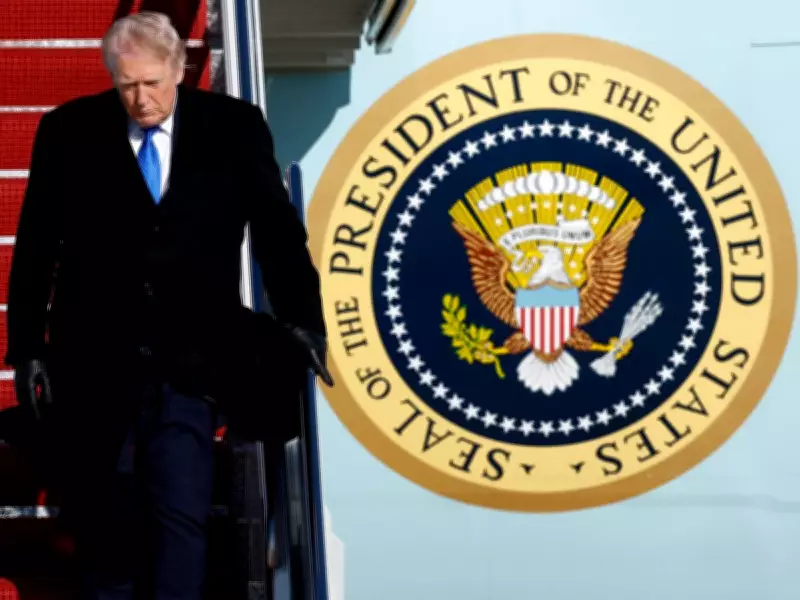
Trump's Mysterious Iranian Contact: Five Key Figures in Secret US Talks
President Donald Trump has revealed that the United States is engaged in discussions with a "top person" within the Iranian system, describing the individual as "most respected" while carefully avoiding any identification. In a statement that has sparked intense speculation, Trump emphasized his protective stance, stating: "I don't want him to be killed." This cryptic revelation comes amid ongoing tensions following over three weeks of conflict involving Israel and the United States against the Islamic Republic.
The Enigmatic Interlocutor
The identity of this senior Iranian figure remains shrouded in mystery, with Trump explicitly confirming it is not Supreme Leader Mojtaba Khamenei, who succeeded his father Ali Khamenei after the latter's killing at the war's outset on February 28. Following the recent Israeli strike that eliminated national security chief Ali Larijani, attention has increasingly focused on several high-ranking officials who might be serving as Washington's secret channel to Tehran.
Five Potential Candidates
1. Parliament Speaker Mohammad Bagher Ghalibaf

Multiple analysts have identified Ghalibaf as the de-facto wartime leader of Iran following the deaths of both Khamenei and Larijani, coupled with Mojtaba Khamenei's absence from public view. With three decades at the center of Iranian power structures, Ghalibaf's career spans both civilian and military spheres, including command of the Revolutionary Guards' aerospace forces, service as Tehran police chief, tenure as Tehran mayor, and his current role as parliament speaker. Despite three unsuccessful presidential bids, he remains regarded as deeply ambitious. After Israeli media reports suggested he was America's interlocutor, Ghalibaf publicly denied any negotiations with the US, labeling such claims as "fakenews."
2. President Masoud Pezeshkian
Elected president in 2024 following former president Ebrahim Raisi's death in a helicopter crash, Pezeshkian represents the more moderate wing of Iranian politics. However, his presidential position does not make him Iran's ultimate authority, as the supreme leader traditionally holds final decision-making power on key matters. The precise functioning of power structures in the post-Ali Khamenei era remains uncertain. Pezeshkian has cultivated an image as a man of the people, recently participating in mass pro-government rallies supporting the Palestinian cause, where he took selfies with supporters. Notably, Larijani participated in the same event shortly before his death.
3. Foreign Minister Abbas Araghchi
A veteran diplomat who assumed the foreign minister role in 2024 after his predecessor Hossein Amir Abdollahian died in the same helicopter crash that killed Raisi, Araghchi has direct experience in US-Iran negotiations. He served as Iran's representative in talks last month with US envoys Steve Witkoff and Jared Kushner in Oman, though those mediated discussions failed to prevent the current conflict. According to recent reports citing US and Iranian officials, Araghchi and Witkoff have maintained "direct communication" in recent days, with Iranian officials characterizing these exchanges as "essentially probes on how to de-escalate the conflict."
4. Other Potential Figures
Beyond these three prominent candidates, other senior Iranian officials with connections to both military and political spheres could potentially serve as intermediaries. The Revolutionary Guards leadership contains several figures with sufficient authority to engage in sensitive diplomatic discussions, while senior members of Iran's security council and diplomatic corps maintain the experience necessary for such delicate negotiations.
5. Unidentified Power Brokers
Given Iran's complex power structures and the supreme leader's traditionally dominant role, the possibility exists that Trump's "top person" operates outside conventional government channels. This could include influential clerics, business leaders with international connections, or military figures with sufficient autonomy to engage in backchannel discussions without immediate public scrutiny.

The Stakes of Secrecy
Trump's deliberate ambiguity regarding his Iranian contact reflects the extreme sensitivity of these discussions. With multiple high-profile Iranian leaders already killed in the conflict, identifying America's negotiation partner could place that individual at immediate risk. The president's protective statement—"I don't want him to be killed"—underscores the dangerous environment in which these diplomatic efforts are unfolding. As both nations navigate this tense period, the identity of this key intermediary may remain concealed until negotiations yield concrete results or the security situation improves sufficiently to allow more transparent dialogue.





