

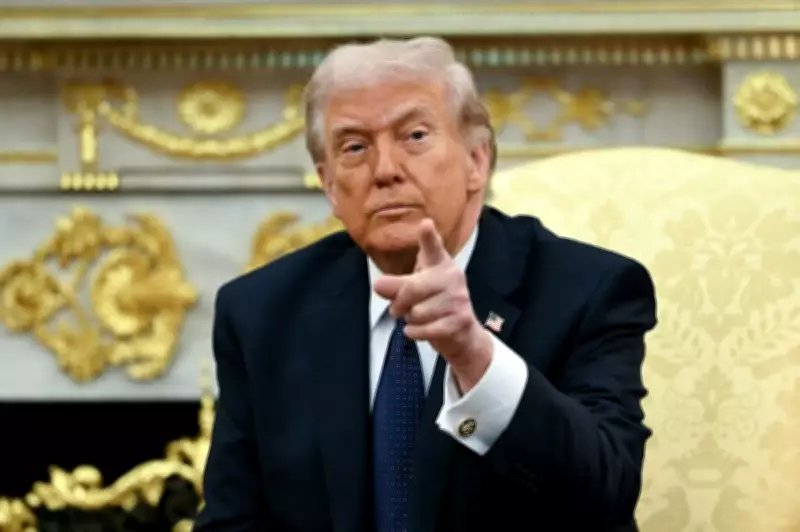
Trump's NATO Withdrawal Threats Spark Global Security Concerns
President Donald Trump's recent comments to a British newspaper have reignited intense speculation about the potential for the United States to withdraw from the North Atlantic Treaty Organization (NATO). In an interview with the Daily Telegraph, Trump labeled NATO as a "paper tiger" and declared that U.S. departure from the defensive alliance is now "beyond reconsideration." These remarks have sent shockwaves through diplomatic circles, particularly among NATO member nations including Canada, raising urgent questions about the future of Western collective security.
Legal Obstacles to Withdrawal
While Trump's rhetoric suggests a straightforward path to leaving NATO, experts emphasize that significant legal hurdles would complicate any withdrawal attempt. According to Aaron Ettinger, associate professor of political science at Carleton University, the process outlined in the NATO Charter appears simple on paper—any member can leave by providing one year's notice. However, domestic U.S. law presents substantial barriers that could prevent presidential action without congressional approval.
"We can't just treat Trump's threats as a TACO Tuesday situation," Ettinger cautioned, referencing the acronym "Trump Always Chickens Out" that describes the president's pattern of making aggressive threats before retreating. "NATO depends on the United States and that makes the threat of abandonment, legal or material, a very real prospect."

The critical legal obstacle stems from legislation introduced in 2023 by then-Senator Marco Rubio, who now serves as Trump's Secretary of State. This law explicitly prohibits any U.S. president from withdrawing from NATO without first consulting Congress and securing approval from two-thirds of the Senate. Rubio's December 2023 social media post, which resurfaced this week, clearly stated that "no U.S. president should be able to withdraw from NATO without senate approval."
Potential Constitutional Battle
Ettinger predicts that any presidential attempt to circumvent this congressional restriction would likely trigger a constitutional crisis ending at the Supreme Court. "It would be a real fight that would probably end up at the Supreme Court," he explained, noting that constitutional law would likely support Rubio's legislation since Congress passed it with substantial support. The current Supreme Court, dominated by conservative justices who frequently align with Trump's positions, would face a landmark decision balancing presidential authority against congressional war powers.
According to the most recent NATO annual report, America accounts for approximately 60% of allies' combined nominal defense expenditures, underscoring the disproportionate U.S. contribution to the alliance. This financial dominance gives Trump considerable leverage even without formal withdrawal, as noted by international affairs experts.
Alternative Disruption Strategies
Wendy Gilmour of the Conference of Defence Associations think-tank observed that Trump has demonstrated a willingness to use executive orders aggressively, even when their legality is questionable. She suggested the president could cause significant disruption to NATO operations without formally exiting the treaty. "He is prepared to use executive orders, even when they are not prima facie legal," Gilmour noted, pointing to potential reductions in U.S. military support for various NATO activities.
Roland Paris, a University of Ottawa international affairs professor, elaborated on this possibility, explaining that Trump could effectively neutralize U.S. participation in NATO through gradual disengagement. "He could effectively withdraw the United States from NATO, even if it was not a formal decision, by removing U.S. military participation in NATO, including by withdrawing the supreme allied commander, which is by tradition an American position," Paris stated. "There would be significant pushback in Congress. He does have the power to unilaterally reduce America's participation in the alliance."

Canada's Response and Alliance Tensions
When questioned about contingency planning for potential U.S. withdrawal, Canadian Foreign Affairs Minister Anita Anand emphasized Canada's unwavering commitment to NATO. "We are continuously and consistently ensuring that our decisions relating to collective defense are made in the context of this multilateral organization," Anand told The Canadian Press. She highlighted that Canada recently met NATO's financial commitment of spending two percent of GDP on defense, reinforcing Ottawa's dedication to the alliance framework.
The tensions within NATO extend beyond Trump's rhetoric. Several member nations, including Spain and Italy, have denied the U.S. military access to their airbases during America's war against Iran. Spain's prime minister has characterized the conflict as illegal and unjust, while Italy requires parliamentary approval for such military cooperation. These disagreements have fueled Trump's frustration with what he perceives as insufficient allied support.
Other U.S. officials have echoed Trump's skepticism about NATO's current value. Secretary of Defense Pete Hegseth declined to reaffirm U.S. commitment to the alliance during a recent press conference, stating "You don't have much of an alliance if you have countries that are not willing to stand with you when you need them." Secretary of State Marco Rubio similarly suggested on Fox News that the administration must "re-examine" whether NATO remains effective or has become a "one-way street" where America bears disproportionate burdens.
Despite floating withdrawal possibilities this week, Trump avoided directly attacking NATO during his prime-time television address about the Iran war. He did, however, urge allies to deploy their militaries to secure the strategic Strait of Hormuz, indicating continued expectations of allied military cooperation even while questioning the alliance's fundamental value.
The evolving situation presents a complex challenge for international security architecture, with potential ramifications extending far beyond diplomatic circles into global stability and defense planning across the Western world.





