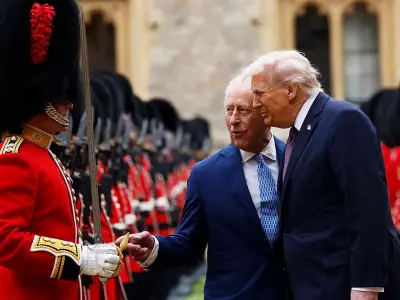
In a critical diplomatic push, U.S. President Donald Trump is set to host Ukrainian President Volodymyr Zelenskyy on Sunday at his Mar-a-Lago club in Palm Beach, Florida. The high-stakes meeting aims to finalize a peace agreement to end the nearly four-year war triggered by Russia's full-scale invasion, even as Moscow ramps up military assaults on Ukrainian cities.
Summit Amid Escalating Violence
The face-to-face talks come during a violent crescendo from Russian forces. On Saturday, ballistic missiles and drones struck Ukraine's capital, Kyiv, killing at least one person and injuring 27 others. Explosions reverberated across the city for hours starting in the early morning, Ukrainian authorities reported.
The attacks continued overnight into Sunday. In the eastern city of Sloviansk, three Russian guided aerial bombs hit private homes, according to the head of the local military administration, Vadym Lakh. The strike killed one man and injured three people, Lakh stated on Telegram.

Zelenskyy, who arrived in the U.S. after meeting with Canadian Prime Minister Mark Carney in Halifax, Nova Scotia, said the leaders plan to discuss security and economic agreements. He vowed to raise "territorial issues" central to the conflict, particularly the status of the Donbas region in eastern Ukraine, which remains fiercely contested.
Diplomatic Momentum and Sticking Points
The Mar-a-Lago meeting underscores significant progress in recent weeks by Trump's top negotiators. Zelenskyy told reporters on Friday that a 20-point draft peace proposal is "about 90% ready," mirroring optimism expressed by U.S. officials after talks in Berlin earlier this month.
A key development involves security guarantees. The U.S. has agreed to offer Ukraine certain protections similar to those afforded NATO members. In a potential major concession, Zelenskyy indicated he is prepared to drop Ukraine's bid for NATO membership if it receives equivalent, binding security assurances designed to deter future Russian aggression.
However, immense hurdles remain. Russian President Vladimir Putin demands that all territories captured by his forces—including four key regions and the illegally annexed Crimean Peninsula—be recognized as Russian. He also insists Ukraine withdraw from additional areas in the east it still holds and abandon its NATO aspirations. Kyiv has publicly rejected all these demands.
Trump has shown some receptiveness to Putin's position, suggesting the Russian leader could be persuaded to end the war if Kyiv cedes territory in the Donbas and Western powers offer economic incentives to reintegrate Russia into the global economy.
International Support and Nuclear Safety Concerns
Canada's Prime Minister Mark Carney, standing alongside Zelenskyy in Halifax, denounced the "barbarism" of Russia's latest attacks. He announced an additional $2.5 billion Canadian (US$1.8 billion) in economic assistance from his government to help Ukraine rebuild, crediting both Zelenskyy and Trump for working toward a "just and lasting peace."
Zelenskyy emphasized that the key to peace is "pressure on Russia and sufficient, strong support for Ukraine." In a post on X on Saturday, he stated, "Ukraine is willing to do whatever it takes to stop this war... We need to be strong at the negotiating table."
Meanwhile, a local ceasefire brokered by the International Atomic Energy Agency (IAEA) near the Russian-occupied Zaporizhzhia Nuclear Power Plant has allowed crucial repairs to begin on damaged power lines. IAEA Director General Rafael Grossi said the work, expected to last several days, aims to reduce the risk of a nuclear accident. Zelenskyy has identified the plant's fate as a critical issue for the U.S.-led negotiations.
The Road Ahead
Zelenskyy cautioned that "the weeks ahead may also be intensive," with sensitive issues still requiring work. He discussed substantive details on Christmas Day with U.S. special envoy Steve Witkoff and Trump's son-in-law, Jared Kushner.

President Trump, who spent much of his first year back in office trying to broker an end to the war, has publicly acknowledged the difficulty of the task—a contrast to his 2024 campaign boast that he could resolve it in a day. After an October meeting with Zelenskyy at the White House, Trump demanded both sides halt fighting and "stop at the battle line," implying Russia could keep seized territory.
Zelenskyy recently indicated a willingness to withdraw troops from eastern Ukraine's industrial heartland if Russia reciprocates and the area becomes a demilitarized zone monitored by international forces. Kremlin spokesman Dmitry Peskov confirmed ongoing contact with U.S. negotiators, stating, "It was agreed upon to continue the dialogue."
As the leaders convene in Florida, the world watches to see if diplomacy can finally silence the guns in a conflict that has reshaped global security, with the outcome hinging on painful compromises and unwavering international solidarity.