

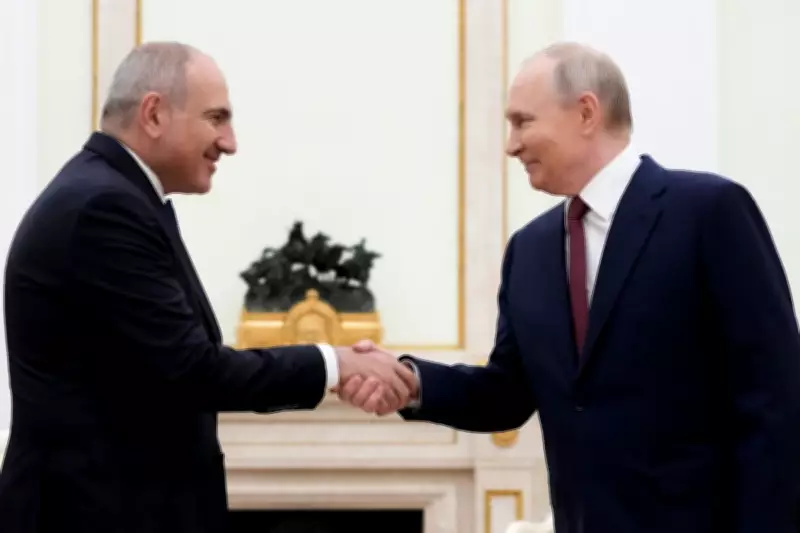
Russian President Vladimir Putin has delivered a firm diplomatic message to Armenia, asserting that the nation cannot pursue membership in both the European Union and the Russia-led Eurasian Economic Union simultaneously. This statement was made during a high-level meeting with Armenian Prime Minister Nikol Pashinyan at the Kremlin in Moscow on April 1, 2026.
A Clear Ultimatum on Economic Alliances
During their discussions, Putin emphasized the incompatibility of Armenia's aspirations to deepen ties with the European Union while remaining a member of the Eurasian Economic Union, a bloc dominated by Russia. This economic union includes countries such as Belarus, Kazakhstan, and Kyrgyzstan, and serves as a cornerstone of Russia's influence in the region.
Strategic Implications for Armenia
Armenia has been navigating a delicate balancing act between its historical ties with Russia and its growing interest in European integration. Prime Minister Pashinyan's government has previously expressed intentions to strengthen relations with the EU, which has raised concerns in Moscow about potential shifts in geopolitical alignment.

Putin's warning represents a significant escalation in diplomatic pressure, forcing Armenia to make a critical choice between Eastern and Western economic partnerships. Analysts suggest this ultimatum could have far-reaching consequences for Armenia's foreign policy and economic development.
Regional Stability at Stake
The Caucasus region has long been a focal point of geopolitical competition between Russia and Western powers. Armenia's strategic decisions could influence the broader stability of the area, particularly given ongoing tensions with neighboring Azerbaijan and Turkey.
This development underscores the complex challenges facing smaller nations caught between major power blocs, as they attempt to maximize economic opportunities while maintaining sovereign autonomy.
Historical Context and Future Prospects
Armenia has been a member of the Eurasian Economic Union since 2015, benefiting from trade preferences and security assurances from Russia. However, recent years have seen growing public and governmental interest in European values and economic models.
The meeting between Putin and Pashinyan highlights the ongoing struggle for influence in post-Soviet states, where economic partnerships are deeply intertwined with security considerations and historical loyalties.
As Armenia contemplates its next steps, the international community will be watching closely to see how this diplomatic standoff resolves and what it means for the future of European-Russian relations in the region.






