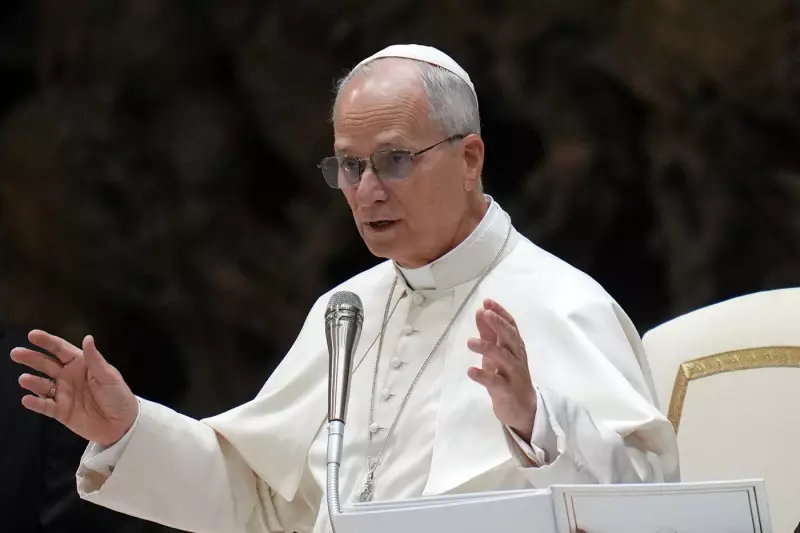
In a significant and pointed address on global affairs, Pope Leo XIV has issued a stark condemnation of nations that resort to military might and coercion to expand their influence and dominion over others. The pontiff's remarks, delivered during his weekly general audience at the Vatican's Paul VI Hall on Wednesday, January 7, 2026, framed the use of force as a fundamental failure of international diplomacy and human solidarity.
A Pontiff's Critique of Global Power Dynamics
The Pope's message served as a direct critique of contemporary foreign policy practices observed in various global hotspots. Without naming specific countries, Pope Leo XIV articulated a broad principle against the assertion of power through aggression. He argued that such actions undermine the foundational principles of mutual respect and peaceful coexistence between sovereign states. His address comes at a time of heightened geopolitical tensions in several regions, making his commentary particularly resonant for world leaders and diplomats.
The setting for this important speech was the Pope's regular Wednesday audience, an event typically focused on spiritual teaching. By choosing this platform, the pontiff elevated a political and ethical issue to a matter of moral urgency for the global Catholic community and beyond. The audience was attended by thousands of faithful, with the message broadcast worldwide, amplifying its reach and potential impact on international public opinion.

The Core Message: Rejecting Force for Dialogue
Central to the Pope's address was the call for a return to dialogue and negotiation as the primary tools for resolving international disputes. He emphasized that true strength and leadership are demonstrated not through domination, but through the patient pursuit of justice and peace. The use of force, he suggested, is often a shortcut that leads to prolonged suffering, instability, and a cycle of retaliation, harming civilian populations most of all.
This stance aligns with the Vatican's long-standing diplomatic tradition of advocating for peaceful conflict resolution. However, the language used by Pope Leo XIV was notably forceful in its condemnation, indicating a heightened concern over current world events. The address serves as a reminder of the Holy See's unique role as a moral voice on the global stage, one that operates outside traditional alliances and power blocs.
Global Implications and Reactions
The Pope's critique is likely to spark discussion in diplomatic circles and among policymakers analyzing the shifting world order. By directly challenging the doctrine that might makes right, the pontiff places a moral lens on actions that are often justified through realpolitik or national security arguments. His words offer support to nations and peoples who feel pressured or threatened by more powerful neighbours or global powers.
As the head of the Roman Catholic Church, Pope Leo XIV's foreign policy statements carry weight with over a billion followers globally and are closely analyzed by governments. This address, delivered from the heart of the Vatican, reinforces the Church's position as an advocate for the vulnerable in international relations and a proponent of a world order based on law and mutual respect, rather than sheer military or economic power.
The full text and context of the Pope's remarks will continue to be studied for its nuanced positions on sovereignty, intervention, and the ethical responsibilities of powerful states in the modern era.