

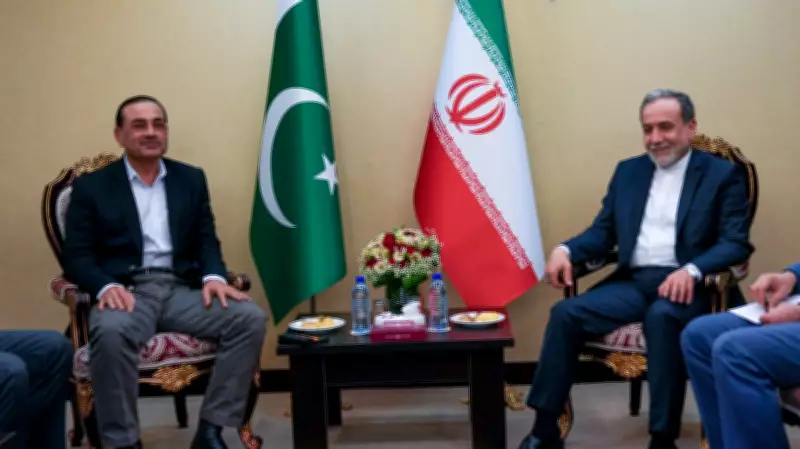
Pakistan's Army Chief Engages in Tehran Diplomacy to Extend Fragile Ceasefire
Pakistan's army chief is scheduled to meet with Iranian officials in Tehran on Thursday, aiming to extend a ceasefire that has paused nearly seven weeks of intense conflict involving Israel, the United States, and Iran. This war has resulted in thousands of casualties and disrupted global markets, particularly through oil flow interruptions. As the ceasefire reaches the halfway point of its original two-week agreement, uncertainty looms over whether frantic diplomatic efforts can secure a lasting deal.
Regional Diplomacy Intensifies Amid Ongoing Hostilities
The meeting coincides with an announcement from President Donald Trump that the leaders of Israel and Lebanon will speak later on Thursday about halting hostilities between their nations. If this conversation occurs, it would mark the first direct dialogue between the two countries' leaders in over three decades. However, both Israeli and Lebanese governments have declined to confirm the planned discussion. Meanwhile, cross-border attacks persisted on Thursday, with the Lebanese militant group Hezbollah and Israel's military continuing exchanges of fire.
The White House indicated that any further negotiations would likely be held in Islamabad, Pakistan's capital, though no final decision has been made regarding resuming talks. The delicate ceasefire, which halted Middle East fighting a week ago, remains in effect despite a U.S. naval blockade of Iranian ports and Iranian counter-threats to target regional ports across the Red Sea.

Pakistan's Mediation Role and Economic Impacts
Pakistan has emerged as a crucial mediator in the conflict, having previously hosted direct talks between the U.S. and Iran in Islamabad. Authorities report that these discussions helped narrow differences between the opposing sides. Mediators are now pushing for a new round of negotiations before the ceasefire expires next week.
The war has significantly disrupted global markets and rattled the world economy, with shipping routes cut off and airstrikes damaging both military and civilian infrastructure throughout the region. Oil prices have recently fallen amid hopes for an end to the fighting, and U.S. stocks surpassed records set in January on Wednesday.
Uncertain Prospects for Israel-Lebanon Dialogue
President Trump stated that Israel and Lebanon are expected to discuss a possible ceasefire later on Thursday, though he did not specify which leaders would participate. Officials from Prime Minister Benjamin Netanyahu's office and the Lebanese government have refused to confirm the potential conversation.
An Israeli minister revealed that Netanyahu will speak with Lebanese President Joseph Aoun on Thursday. "Today the prime minister will speak for the first time with the president of Lebanon, after so many years of a complete disconnection in the dialogue between the two countries," said Gila Gamliel, Israel's Minister of Science and Technology, during an Army Radio interview on Thursday morning. Gamliel, who attended a cabinet meeting about negotiations with Lebanon on Wednesday night, is part of Israel's security cabinet. She expressed hope that the talks "will hopefully ultimately lead to prosperity and flourishing" between the nations.
Lebanon and Israel conducted their first direct diplomatic discussions in decades on Tuesday in Washington, following more than a month of war between Israel and Iran-backed Hezbollah. However, hostilities continued on Thursday, with Hezbollah launching rockets and drones at towns in northern Israel, while Israeli forces intensified fire against southern Lebanon, particularly around Tyre, Nabatieh, and the strategic border town of Bint Jbeil.
Israel and Lebanon have technically been at war since Israel's establishment in 1948, and Lebanon remains deeply divided over diplomatic engagement with its neighbor.
Progress Reported in U.S.-Iran Negotiations
Despite strains from the U.S. blockade on Iranian ports and renewed Iranian threats, regional officials reported progress in negotiations. They told The Associated Press that the United States and Iran have reached an "in-principle agreement" to extend the ceasefire to allow for further diplomacy. These officials spoke on condition of anonymity due to the sensitive nature of the talks.

While mediators worked toward peace, tensions continued to simmer. Ali Abdollahi, commander of Iran's joint military command, threatened to halt regional trade if the U.S. does not lift its naval blockade. Additionally, a newly appointed military adviser to Iranian Supreme Leader Mojtaba Khamenei expressed opposition to extending the ceasefire.
Key Sticking Points in Mediation Efforts
Mediators are seeking compromises on three main issues that derailed direct talks last weekend: Iran's nuclear program, control of the Strait of Hormuz, and compensation for wartime damages, according to a regional official involved in the mediation efforts.
Iranian Foreign Ministry spokesman Esmail Baghaei stated that Iran is open to discussing the type and level of its uranium enrichment, but emphasized that his country "based on its needs, must be able to continue enrichment," as reported by Iranian state media.
The conflict has resulted in significant casualties, with at least 3,000 people killed in Iran, over 2,100 in Lebanon, 23 in Israel, and more than a dozen in Gulf Arab states. Thirteen U.S. service members have also lost their lives.
U.S. Treasury Secretary Scott Bessent announced that the Trump administration would increase economic pressure on Iran through new sanctions on countries conducting business with it, describing the move as the "financial equivalent" of a bombing campaign.
Pakistan's Prime Minister Shehbaz Sharif arrived in Qatar on Thursday as part of a regional visit focused on discussions about the ongoing U.S.-Iran peace process and efforts to promote stability in the Middle East amid continuing tensions, according to his office.
International Calls for Strait of Hormuz Reopening
Chinese Foreign Minister Wang Yi stated that a "window of peace" was opening during a phone call with his Iranian counterpart, who briefed him on the latest developments in Iran-U.S. negotiations and Tehran's considerations for next steps, according to a statement from China's foreign ministry released late Wednesday.
Wang told Iranian Foreign Minister Abbas Araghchi that the situation has reached a critical juncture between war and peace. He emphasized that Iran's sovereignty, security, and legitimate rights should be respected as a littoral state of the Strait of Hormuz, while freedom of navigation and safety through the strait should be ensured.
Since the war began, Iran has restricted maritime traffic through the Strait of Hormuz, which typically handles one-fifth of global oil shipments during peacetime. Tehran's effective closure of the strait caused oil prices to skyrocket, increasing costs for fuel, food, and other basic goods far beyond the Middle East. The U.S. has responded with a blockade on Iranian shipping.
U.S. Central Command reported on Wednesday that no ships had passed the blockade since it was imposed two days earlier, while ten merchant vessels complied with U.S. directives to turn around and reenter Iranian waters.
The blockade aims to pressure Iran, which has exported millions of barrels of oil, primarily to Asia, since the conflict began on February 28. Much of this oil has likely been transported through so-called dark transits that evade sanctions and oversight, providing crucial cash flow to sustain Iran's operations.





