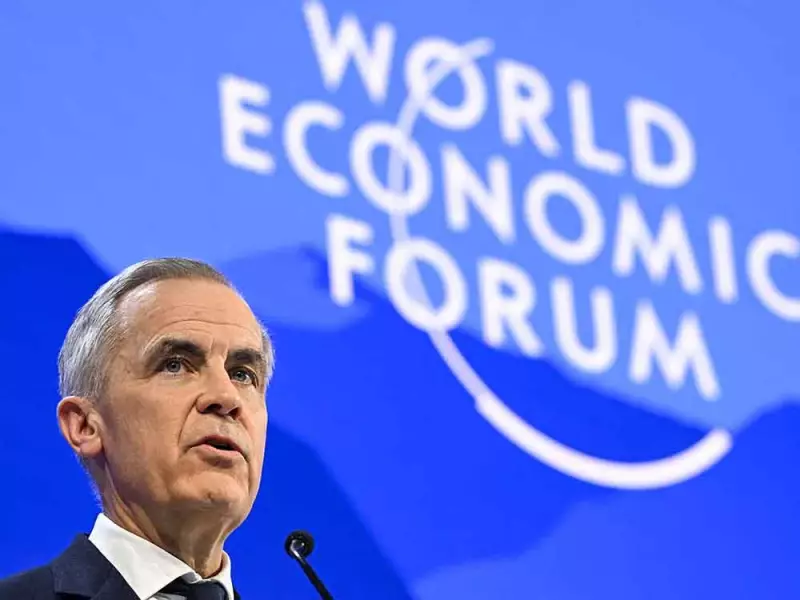
Prime Minister Carney Delivers Blunt Assessment at World Economic Forum
Canadian Prime Minister Mark Carney used his platform at the World Economic Forum in Davos to deliver a sobering message about the current state of global affairs. In a speech that challenged conventional diplomatic language, Carney declared that the "rules-based international order" that has governed international relations for decades is effectively dead.
A Call for Middle Power Unity
Carney argued that recent global events have demonstrated the failure of existing international systems, leaving Canada and other middle powers with no alternative but to forge new alliances. These partnerships would serve as a bulwark against what he described as "pressure tactics and intimidation" by dominant world powers.
"Stop invoking the 'rules-based international order' as though it still functions as advertised," Carney told the Davos audience. "Call the system what it is: a period where the most powerful pursue their interests using economic integration as a weapon of coercion."

Arctic Tensions and Global Implications
The prime minister's remarks came amid escalating tensions in the Arctic region, where he reaffirmed Canada's support for Greenland's sovereignty. Carney emphasized that Greenland and Denmark possess the "unique right to determine Greenland's future," directly addressing recent statements from U.S. President Donald Trump about American security interests in the territory.
Carney's speech represented more than just a critique of current geopolitics—it amounted to a call for a fundamental restructuring of international cooperation among mid-sized nations. He described such alliances as potentially "the last line of defence" in an era when dominant states increasingly use their economic and military power to impose their will on others.
NATO Commitments and Transatlantic Rifts
Despite his critique of the broader international order, Carney reaffirmed Canada's commitment to NATO, particularly Article 5—the alliance's mutual defence clause. He noted that Canada is working with NATO partners to secure the alliance's northern and western flanks, even as transatlantic relationships face significant strain.
The timing of Carney's address was particularly significant, coming just hours after French President Emmanuel Macron criticized Trump's trade strategy, which includes threats of additional tariffs on European nations unless the U.S. is allowed to acquire Greenland. This widening rift between traditional allies formed the backdrop to Carney's call for middle power solidarity.
A Warning Against Accommodation
Carney warned against the temptation for smaller nations to accommodate larger powers in hopes of avoiding conflict. "Faced with strong-arm tactics by larger nations, there is a strong tendency for countries to go along to get along. To accommodate. To avoid trouble. To hope that compliance will buy safety," he stated. "It won't."
The prime minister delivered his most memorable line when he declared: "Middle powers must act together because if you are not at the table, you are on the menu." This stark metaphor captured the urgency of his message about the need for collective action among nations that might otherwise find themselves vulnerable to coercion.
North American Trade Considerations
Carney's remarks also carried implications for North American relations, as Canada and Mexico prepare for potential renegotiations of the North American trade agreement. American officials have publicly discussed the possibility of breaking up the existing pact in favor of bilateral negotiations, adding another layer of complexity to the regional dynamic Carney addressed in his speech.
The prime minister's Davos appearance concluded as President Trump prepared to arrive at the summit, though it remained unclear whether the two leaders would meet directly. Carney's departure from traditional diplomatic language and his direct critique of current power dynamics marked a significant moment in Canada's foreign policy positioning on the global stage.