

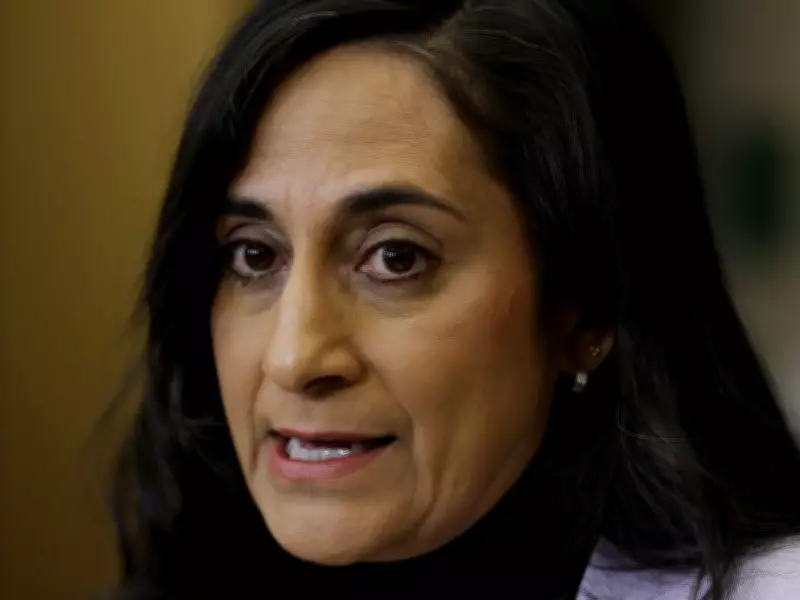
Canada's Foreign Minister Declares Leadership Mission Amid Global Disorder
Foreign Affairs Minister Anita Anand has emphatically declared that Canada's current "mission" is to assume a leadership role on the international stage during a period of significant global upheaval. In a keynote address delivered at the prestigious 2026 Chatham House Global Trade Conference in London on Thursday, Anand leaned further into the Carney government's emerging strategy of positioning Canada at the center of the world's middle powers.
A Call to Lead from the Center
"This is Canada's moment indeed to lead in the area of energy in all its forms," Anand stated during her prepared remarks. She concluded this portion of her talk by asserting, "This is Canada's mission. This is our moment to lead." The minister argued that a nation's true greatness is derived not solely from domestic achievements but from providing leadership that yields benefits for the entire world.
The Liberal government, under Prime Minister Mark Carney, is actively cultivating an unusually activist international profile. Anand's address served to further elaborate on concepts initially outlined by Carney during his January speech at the World Economic Forum in Davos, Switzerland. The core premise involves middle powers collaborating more closely, often independently of traditional American leadership.

Filling a Vacuum in the Global Order
Prime Minister Carney's Davos address garnered international attention for crystallizing a widespread sentiment: the post-World War II global order has experienced a profound "rupture." Carney posited that the old "rules-based international order" is effectively gone and implied that the United States can no longer be reliably counted upon to lead the alliance of democracies.
In a world increasingly dominated by "hegemons," Carney delivered a memorable warning: "Middle powers must act together because if you are not at the table, you are on the menu." This philosophy has become a cornerstone of Ottawa's foreign policy direction.
From International View to Leadership Role
In recent weeks, the Canadian government has intensified its emphasis on steering this coalition of smaller nations. Prime Minister Carney has emerged in a leading role, rallying international allies on critical issues such as Arctic sovereignty and global energy security.
During her London address, Anand seemed to advance this vision a step further. She indicated Canada's intention to transition from merely holding an international worldview to actively adopting a concrete leadership position. The minister affirmed that Canada will steadfastly uphold its core values—including human rights, gender equality, environmental stewardship, and trade diversification—even amidst what she described as a "profound moment of geo-political challenges and change."
"This is the moment where we need to ensure, as Prime Minister Carney mentioned in his Davos speech, that we stand for our principles and we do so individually and collectively with our work together with like-minded countries," Anand stated.
A Strategic Shift in Foreign Policy
This assertive stance marks a clear strategic shift from the international priorities of former Prime Minister Justin Trudeau, who primarily emphasized the global promotion of progressive values. In his first year, Prime Minister Carney has pivoted towards a foreign policy focused on enhancing trade relationships and constructing strategic counterweights to global superpowers.
Anand's keynote, while largely centered on the practicalities of trade diversification, provided significant insight into this evolving diplomatic doctrine. It reinforces the Carney government's commitment to positioning Canada not just as a participant, but as a leading architect, in the new and disorderly landscape of international relations.






