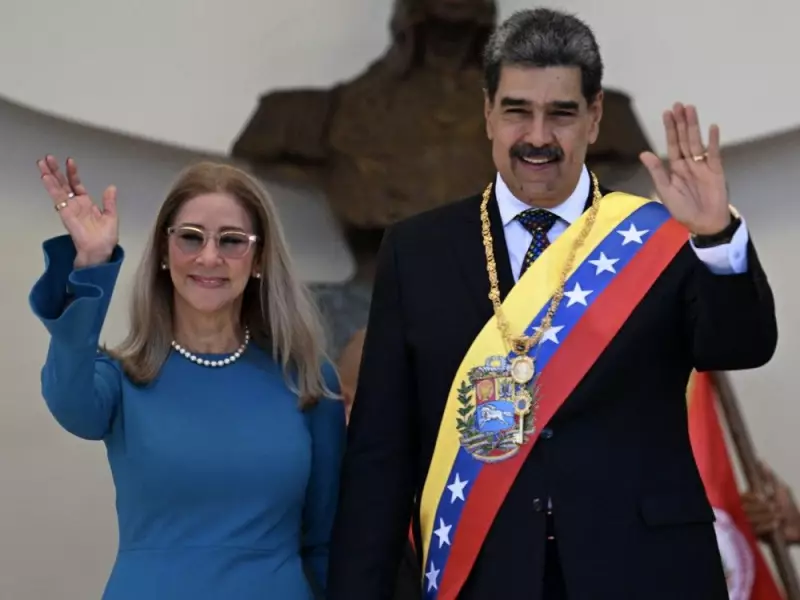
The dramatic capture of Venezuelan President Nicolás Maduro by United States military forces has plunged the South American nation's long-ruling political elite into a profound crisis of leadership. For 27 years, the socialist "Chavista" movement, founded by the late Hugo Chávez, has held power. Now, with Maduro and his influential wife, Cilia Flores, removed from the country and facing trial in the U.S., the stability of the inner circle known as the "club of five" is being severely tested.
The Balance of Power is Broken
Anointed by Hugo Chávez before his death in 2013, Maduro maintained a firm grip on Venezuela until his seizure on January 3, 2026. He ruled not alone, but alongside a tight-knit group of powerful leftist figures. This group included his wife, Cilia Flores; former vice president Delcy Rodríguez, who is now the country's interim leader; her brother, Jorge Rodríguez, the speaker of parliament; and their internal rival, hardline Interior Minister Diosdado Cabello.
"It's like a club of five," a diplomatic source in Caracas explained anonymously. "They can speak, they have a voice in the government, but Maduro was the one who kept the balance. Now that he's gone, who knows?"

The image of a handcuffed and blindfolded Maduro being transported to New York dominated global headlines, marking a stunning fall for the 63-year-old former bus driver. For months, he had been a primary target of U.S. President Donald Trump, who accused him of drug trafficking. Maduro responded with defiant, near-daily rallies broadcast live, dancing to techno music and chanting "No war, yes peace!" in English.
An Inner Circle Built on Loyalty and Control
Frequently underestimated by external observers, Maduro proved adept at eliminating internal resistance and marginalizing the political opposition. His cult of personality was fostered through state media, with murals, songs, and even an animated cartoon called "Super Moustache" that depicted him as a superhero battling imperialism alongside "Super Cilita," a character based on Flores. Toy figurines of both characters were also produced.
The military, led by Defense Minister Vladimir Padrino López, swore absolute loyalty to him. This control extended to the Rodríguez siblings, who held key levers of power. Delcy Rodríguez, as vice president, controlled the crumbling economy and the vital oil industry. Her brother Jorge served as the regime's chief negotiator with both the domestic opposition and the United States, while Delcy represented Maduro on international stages.
Publicly, both are known for fiery, belligerent rhetoric filled with insults against the "enemies of the fatherland." Behind the scenes, however, they are regarded as skilled and calculating political operators.
A Struggle for Survival Begins
In the immediate aftermath of the capture, Venezuela's Supreme Court ordered Vice President Delcy Rodríguez to assume the role of interim leader. After initial defiant calls for Maduro's return, Rodríguez struck a notably different tone on Sunday, calling for a "balanced and respectful relationship" between Venezuela and the United States—a significant shift from the previous hostility.
This pivot underscores the primary objective of the remaining leadership. "The top level of government has survival as its absolute priority," said Antulio Rosales, a political scientist and professor at York University in Canada.
The question now is whether the "club" can hold together without Maduro as its arbiter. The dynamic between the Rodríguez siblings and their rival, Diosdado Cabello, will determine the immediate future of the Chavista state. The arrest has not only removed a president but has also shattered the delicate equilibrium that sustained one of Latin America's most controversial governments for over a decade.