Trump's White House Governors Dinner Sparks Controversy Amid Partisan Tensions
The annual White House dinner with governors, traditionally a bipartisan social event, became a flashpoint of controversy during President Donald Trump's second term. Scheduled for Saturday, February 21, 2026, the gathering of the National Governors Association (NGA) was marred by political disputes and boycotts, highlighting deepening divisions in American politics.
Pre-Dinner Turmoil and Exclusion Threats
Ahead of the event, President Trump ridiculed the NGA's leadership, which included Republican Governor Kevin Stitt of Oklahoma and Democratic Governor Wes Moore of Maryland. In a move that escalated tensions, Trump initially refused to invite Moore and Colorado Governor Jared Polis, both Democrats, to a working meeting at the White House on Friday. He only relented at the last minute, but the damage was already done.
The situation worsened when the Friday event ended abruptly after Trump learned of the Supreme Court's decision to strike down his sweeping tariff policy. This ruling added fuel to the fire, with dozens of Democratic governors threatening to boycott Saturday's dinner if their colleagues were blocked from the earlier meeting. Even after Moore's attendance was secured, some Democrats, including Massachusetts Governor Maura Healey, declared they would not participate, calling the proceedings a "farce."

A Dinner Without Democrats
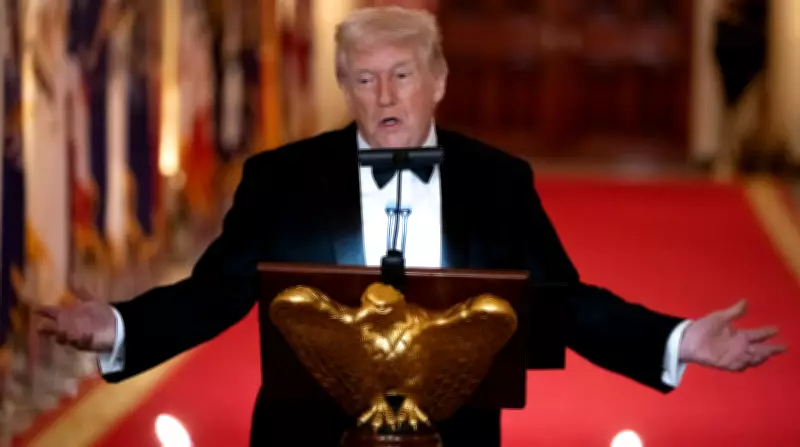
When the black-tie dinner finally took place, no Democratic governors were spotted in the room. The event was attended solely by top administration officials and Republican governors, who enjoyed an evening with tall candles arranged on tables. In brief remarks, President Trump joked that state leaders might look in the mirror and think, "I should be president, not him." He did not criticize any Democrats by name but blamed Maryland and Virginia, both led by Democratic governors, for a sewage spill in the Potomac River near Washington, despite the issue involving a federally regulated utility overseen by the U.S. Environmental Protection Agency.
Reflections on Bipartisanship and Governance
Vice President JD Vance praised the governors for making tough decisions, noting that in their positions, "nobody blames you when anything goes wrong." However, the absence of Democrats underscored the event's shift from its traditional role. Past attendees, such as former Arkansas Governor Asa Hutchinson, a Republican who once chaired the NGA, recalled the dinner as a "glowing evening in the White House" that fostered connections across party lines. Hutchinson shared an anecdote about being seated with then-Rhode Island Governor Gina Raimondo, a Democrat, and getting to know her family, emphasizing the value of such bipartisan interactions.
Conference Focus on Key Issues
The final day of the NGA conference on Saturday centered on critical topics like affordability and political civility. During a discussion on immigration, Governors Moore and Stitt acknowledged that both parties have failed to address the issue over decades. Stitt argued for empowering states to issue workforce permits and warned against false political assumptions, such as the belief that all Democrats want open borders or all Republicans hate immigrants. He highlighted that even "rural Oklahoma Trump voters" have privately expressed reliance on individuals seeking work authorization for their businesses.
Moore Declares Success Despite Challenges
Despite the turmoil, Governor Wes Moore declared the conference a success. He stated, "There were a lot of things that were put in our way to try to distract us from our mission, to try to divide us as individual governors, to try to make the mission of this organization where a bipartisan group of governors can come together and solve problems on behalf of our people, to try to make our work irrelevant. To all the people who tried to make that happen, you failed." This statement underscored the resilience of the NGA's bipartisan goals amid partisan strife.
The 2026 White House governors dinner, once a symbol of unity, now stands as a testament to the polarized state of American politics under President Trump's leadership.