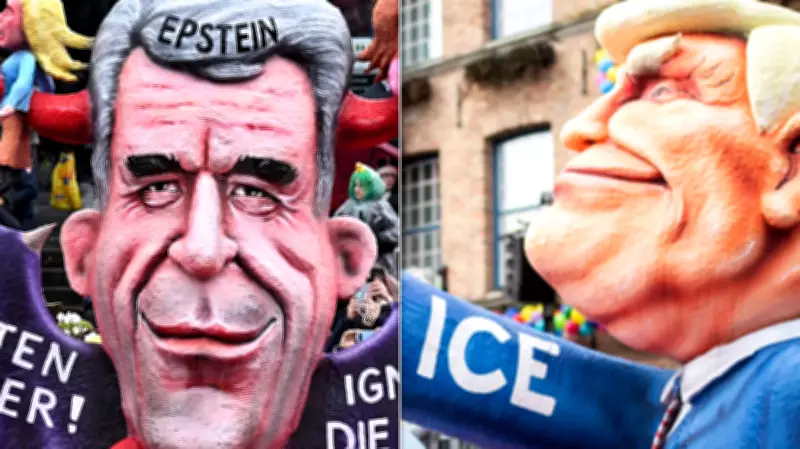
Former U.S. President Donald Trump has once again become a central figure of satirical mockery at the annual Rose Monday carnival parade held in Düsseldorf, Germany. This event, known for its bold and often provocative political commentary, featured several floats that directly targeted Trump and his associates, sparking discussions about international perceptions and the role of satire in public discourse.
Controversial Depictions of Trump and Political Themes
One particularly striking effigy of Trump showed him with "ICE"—referring to Immigration and Customs Enforcement—written on his sleeve. In this depiction, Trump was portrayed punching Jesus Christ in the face, with Jesus wearing a shirt labeled "Love & humanity." This imagery has drawn attention for its stark contrast between themes of enforcement and compassion, highlighting criticisms of Trump's immigration policies and their perceived humanitarian impacts.
Trump and Putin in a Struggle for Europe
Another float presented a dramatic scene where Trump was shown fighting with Russian President Vladimir Putin, both depicted as attempting to devour Europe. This satirical piece plays on geopolitical tensions and fears of foreign influence, using exaggerated visuals to comment on power dynamics and international relations. Putin was also separately depicted knifing satire itself, a meta-commentary on the suppression of free expression and critical voices in political contexts.

Jeffrey Epstein Imagery as a Vampire Figure
Adding to the controversy, an image of the late convicted sex offender Jeffrey Epstein, who was once a close associate of Trump, was transformed into a vampire in one of the floats. Messages on his wings read "everyone protects the perpetrators" and "everyone ignores the victims," directly addressing the Epstein scandal and broader issues of accountability and justice in high-profile cases. This depiction underscores the carnival's willingness to tackle sensitive and ongoing societal debates through art.
Historical Context of Trump at the Düsseldorf Carnival
This is not the first time Trump has been featured in the Düsseldorf carnival's satirical floats. Since 2016, he has been a recurring target, with past depictions including various political and personal critiques. For instance, in 2024, floats showed him in unflattering scenarios, while in 2021, he was mocked for his handling of the pandemic. Earlier years, such as 2019 and 2018, featured him in conflicts with other world leaders or as a symbol of divisive politics. These consistent portrayals reflect the carnival's role as a platform for ongoing political commentary and its engagement with global events.
The Rose Monday parade in Düsseldorf is part of a long tradition of carnival celebrations in Germany, where satire and humor are used to critique authority and social issues. By focusing on figures like Trump, Putin, and Epstein, the event not only entertains but also provokes thought about leadership, morality, and the power of visual protest. As these floats circulate in media and public discussions, they contribute to a broader dialogue on how satire can influence public opinion and hold powerful individuals accountable in an increasingly interconnected world.