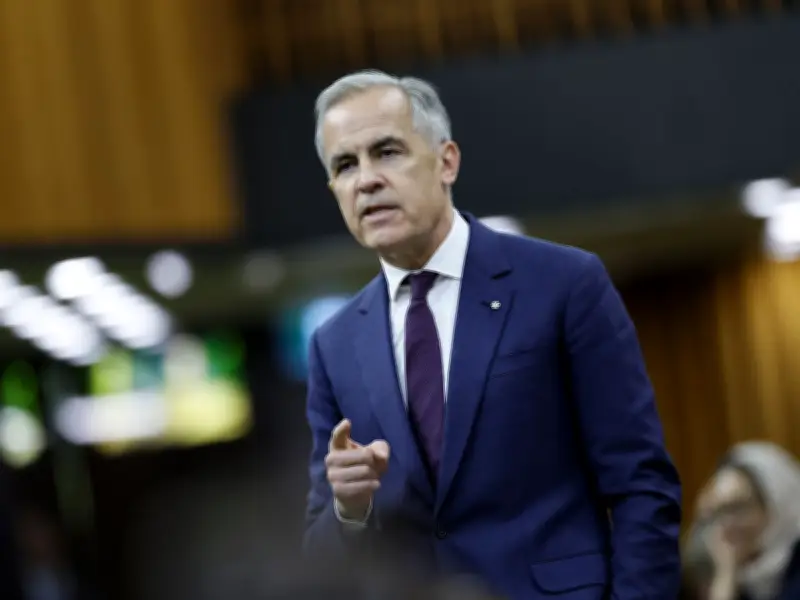
The federal government has announced a multi-billion-dollar plan to accelerate the adoption of artificial intelligence across Canada, aiming to support companies, including AI startups, and enhance AI literacy, skills, and public trust in the technology.
A Pragmatic and Prudent Approach
Prime Minister Mark Carney emphasized the importance of a balanced strategy. "The question is not whether AI will transform our lives. AI is already changing how we work, how we learn and how we connect," Carney said in a speech. "The question is will it improve the lives of all Canadians or benefit only a few. That's why we must take a positive, pragmatic and prudent approach that builds safe, reliable and sovereign AI for workers and businesses (and) for Canada and our allies."
Canada was the first country to release a national AI plan in 2017, but the new blueprint, called AI for All, released Thursday, is designed to lift Canadian productivity and economic growth while safeguarding against AI-related risks.

Key Funding Initiatives
Business leaders have long urged the government to provide more support for homegrown companies to adopt AI, scale up, and move from research to commercialization. The new plan includes several funding measures:
- The Business Development Bank of Canada's $500-million LIFT program to help businesses access financing for AI tools.
- A $700-million top-up of the Compute Access Fund to help small and mid-sized businesses access computing power.
- $500 million for a regional AI initiative to speed up adoption and commercialization across the country.
The government aims to increase business use of AI to 60 per cent by 2034, up from the current 12 per cent.
Support for High-Potential Companies
Ottawa is also launching a $500-million Canadian Tech Growth Fund that will provide financing for high-potential companies and allow the government to take equity stakes. The recently launched Sovereign Wealth Fund will also support these companies where appropriate.
More than 3,500 Canadian companies are actively developing AI models, tools, and applications, collectively raising over $37 billion in venture capital funding, according to the government.
Building Trust and Safety
Despite the progress, only 34 per cent of Canadians are willing to trust AI, and nearly 80 per cent worry about negative outcomes, according to a 2025 study by KPMG International LLP and the University of Melbourne. To address these concerns, the government said it will introduce online safety laws and update consumer privacy rules to protect Canadians and strengthen control over personal data, though no timeline was provided.
Additionally, $50 million will be allocated to the Canadian AI Safety Institute to track emerging AI risks, advance technical research, and conduct transparent evaluations of AI models.